Table of Contents
Key takeaway: Energy Saver North Carolina pays a large share of home energy improvements in qualifying homes, from insulation and air sealing to heat pumps and water heaters, and the discount comes off the contractor’s quote instead of arriving as a check months later. Peak Energy provides the insulation, air sealing and duct sealing portion of that list. Through HOMES, households below 80% of Area Median Income may receive 100% of eligible project costs up to $16,000. Households between 80% and 150% AMI may receive 50%, up to $2,000 or $4,000 depending on modeled energy savings. The project must be approved and the rebate reserved before work begins. Final eligibility and amounts are determined by Energy Saver North Carolina.
Updated September 2, 2026. Reflects current Energy Saver North Carolina HOMES requirements and the HEAR program changes effective September 1, 2026.
Picture a two-story built in the late 1990s in Apex or Holly Springs. The upstairs runs warm all summer, the ducts snake through a 130°F attic, and the insulation up there has settled to a few inches of gray fluff. Every one of those problems has a well-understood fix. What has changed in 2026 is who pays for it. If your household income is at or below 150% of the Area Median Income limit for your county and household size, the state will now cover a meaningful share of exactly that work, and for many Wake County families the share is most or all of it.
This guide walks through what the program pays for, who qualifies, what the math looks like on a real-sized project, and what happens between your first phone call and the finished job. The Wake County household-size income table and Peak Energy’s commercial details live on our Energy Saver NC rebates and Wake County income limits page.
What Energy Saver NC pays for in a Triangle home
Energy Saver North Carolina is the state’s version of the federal Home Energy Rebates program, funded through the U.S. Department of Energy and administered by the North Carolina Department of Environmental Quality. It is active in all 100 counties. The official site is energysavernc.org and the program line is 866-998-8555. Homeowners sometimes assume a program covering up to 100% of a project must be a scam. This one is real, and every registered contractor signed a participation contract covering licensing, insurance and how the rebate is applied.
The program covers far more than any one contractor offers. It runs two paths. HOMES (Homeowners Managing Efficiency Savings) covers whole-home weatherization: insulation, air sealing, duct sealing, duct insulation and other approved measures. HEAR (Home Electrification and Appliance Rebates) pays set amounts toward heat pumps, heat pump water heaters, electrical panels, wiring and certain appliances. Peak Energy provides three of the HOMES measures, insulation, air sealing and duct sealing, and those are what this article focuses on. HEAR is covered briefly further down, and for heat pumps we point homeowners to an HVAC contractor.
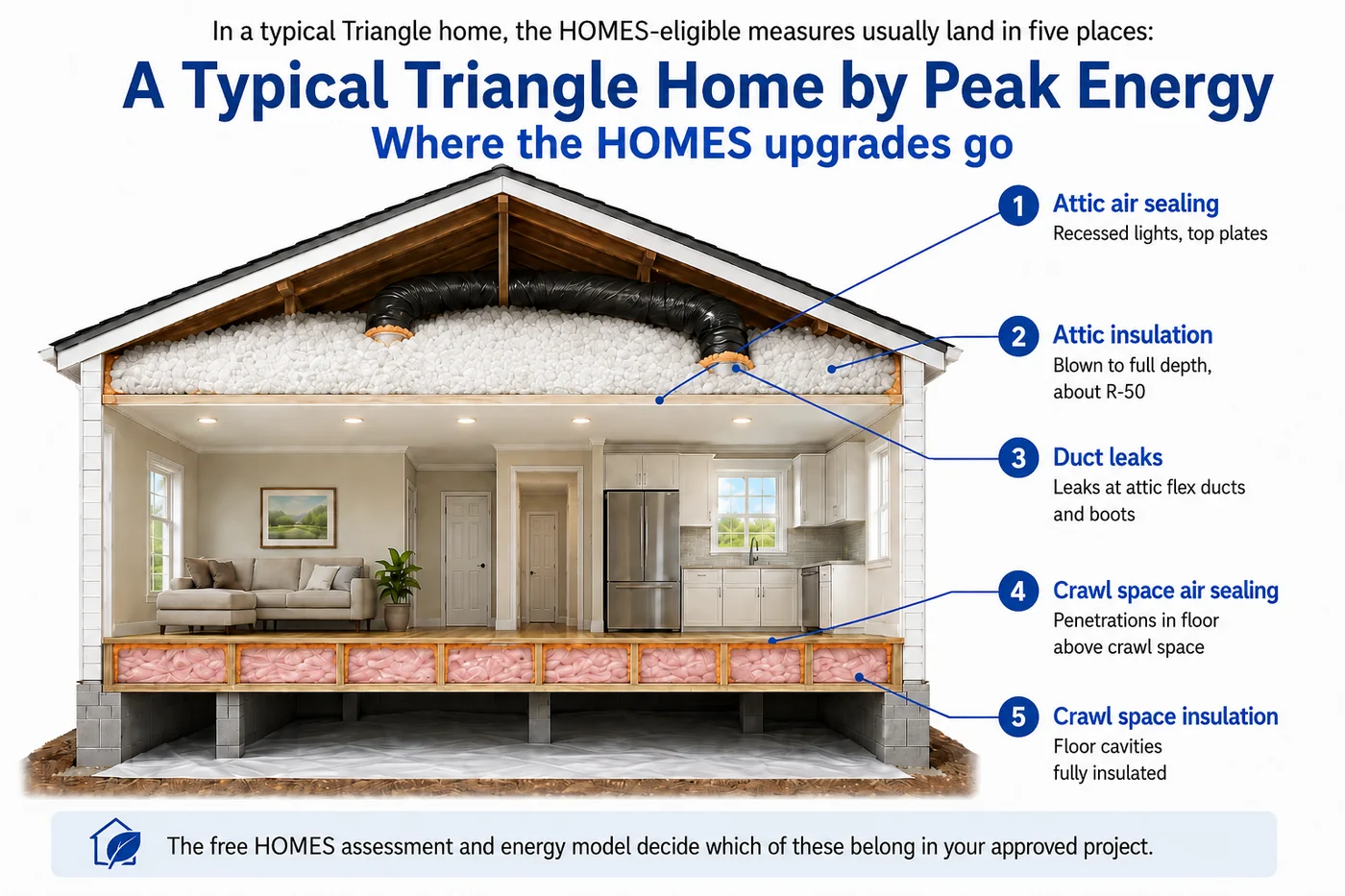
In a typical Triangle house, the HOMES-eligible measures usually land in five places:
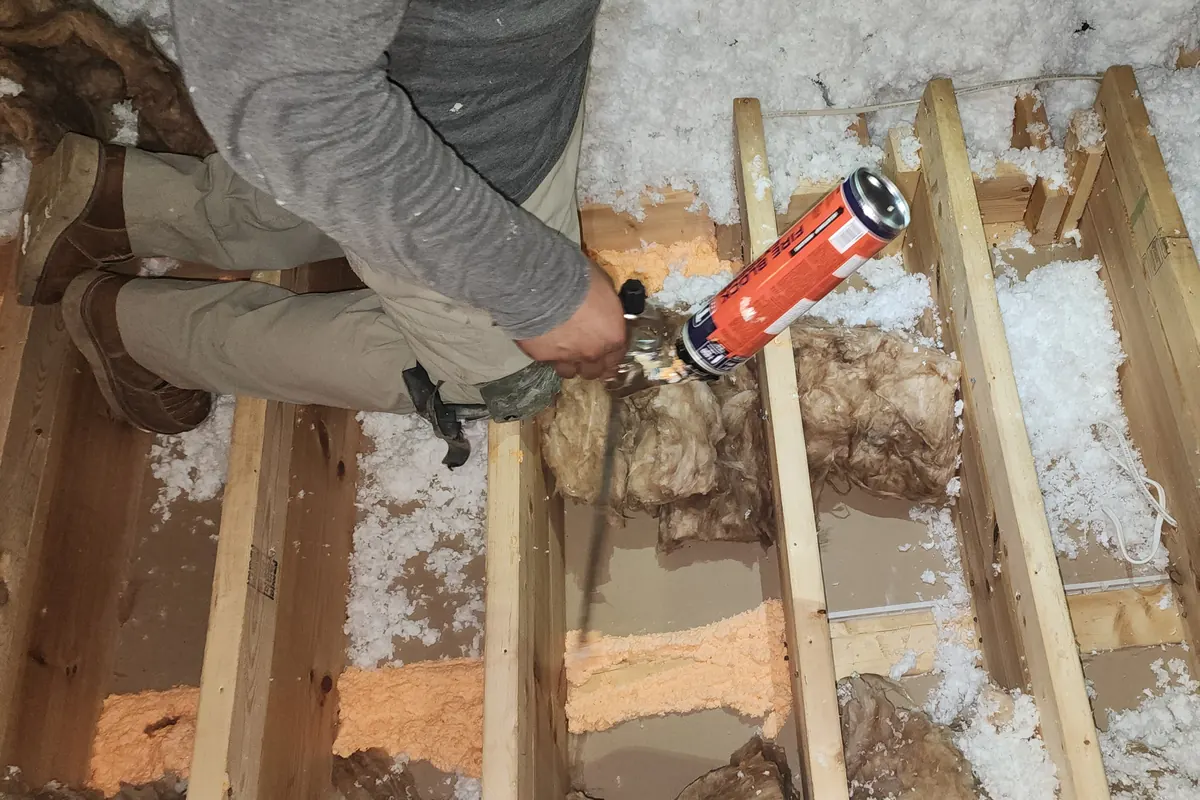
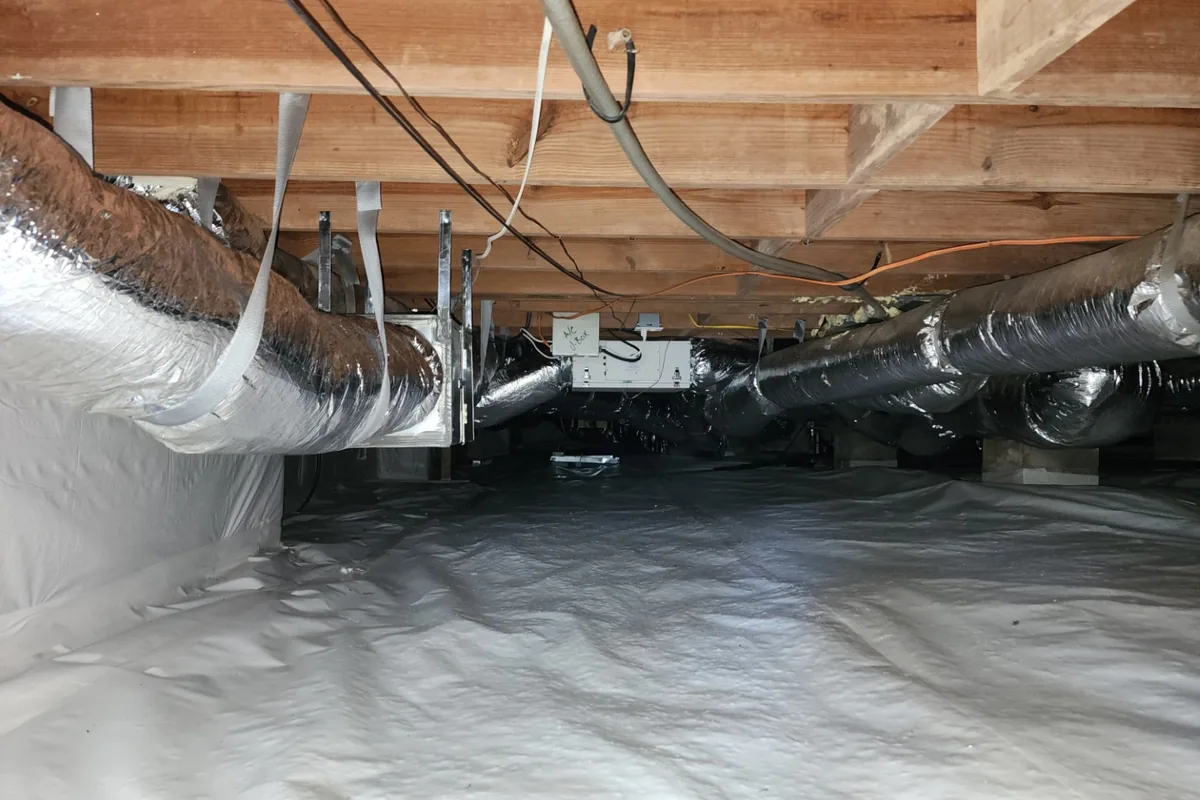
Here is what those upgrades look like on actual Wake County jobs:
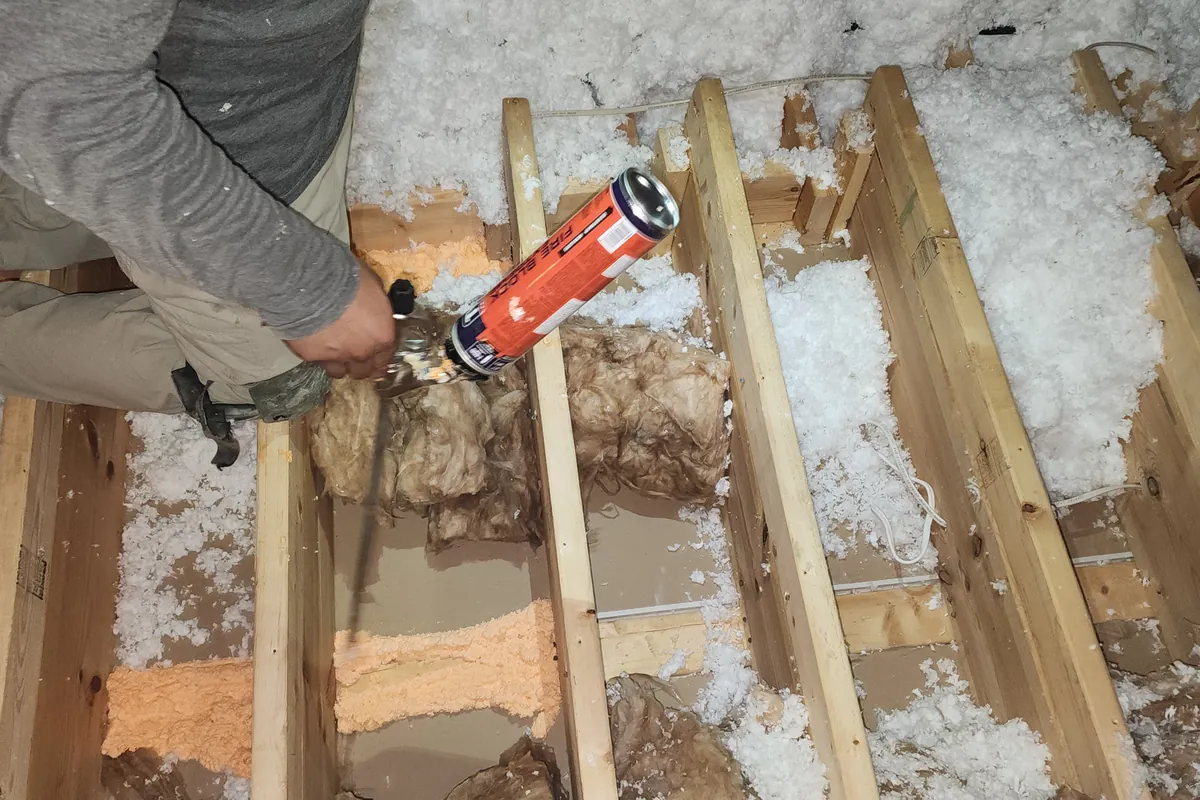
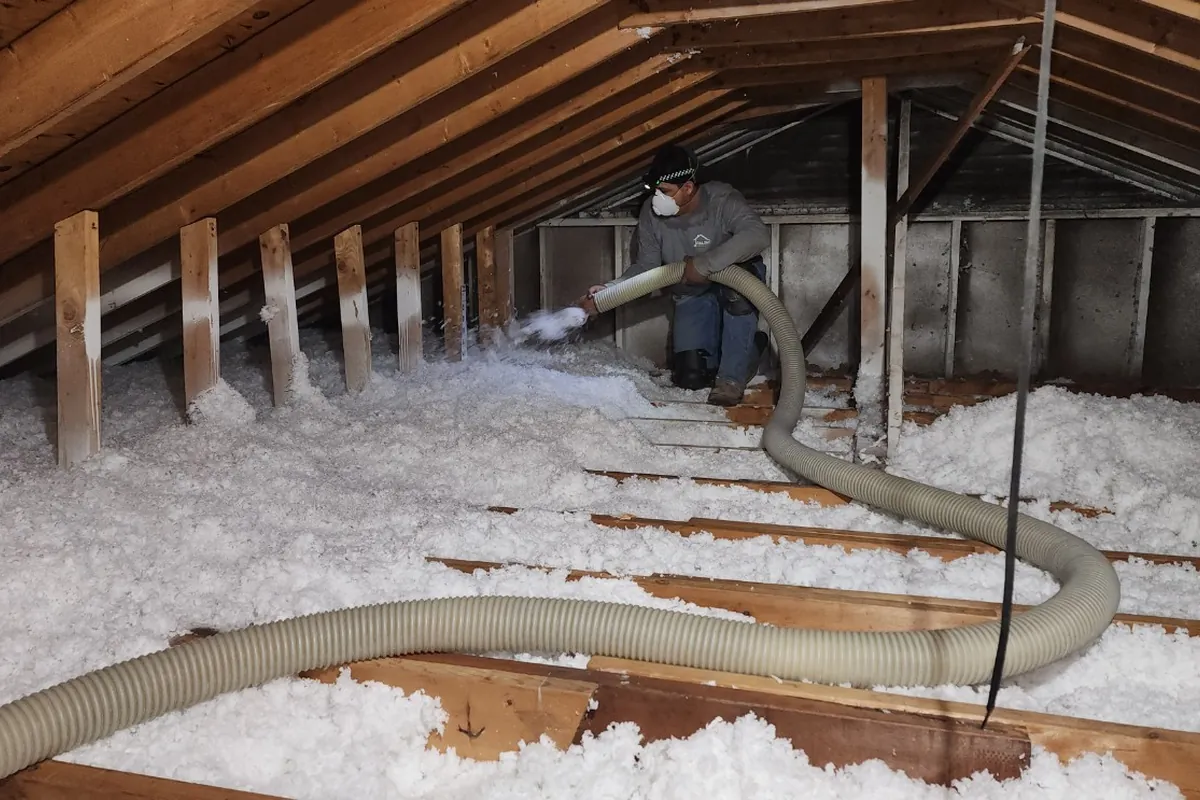
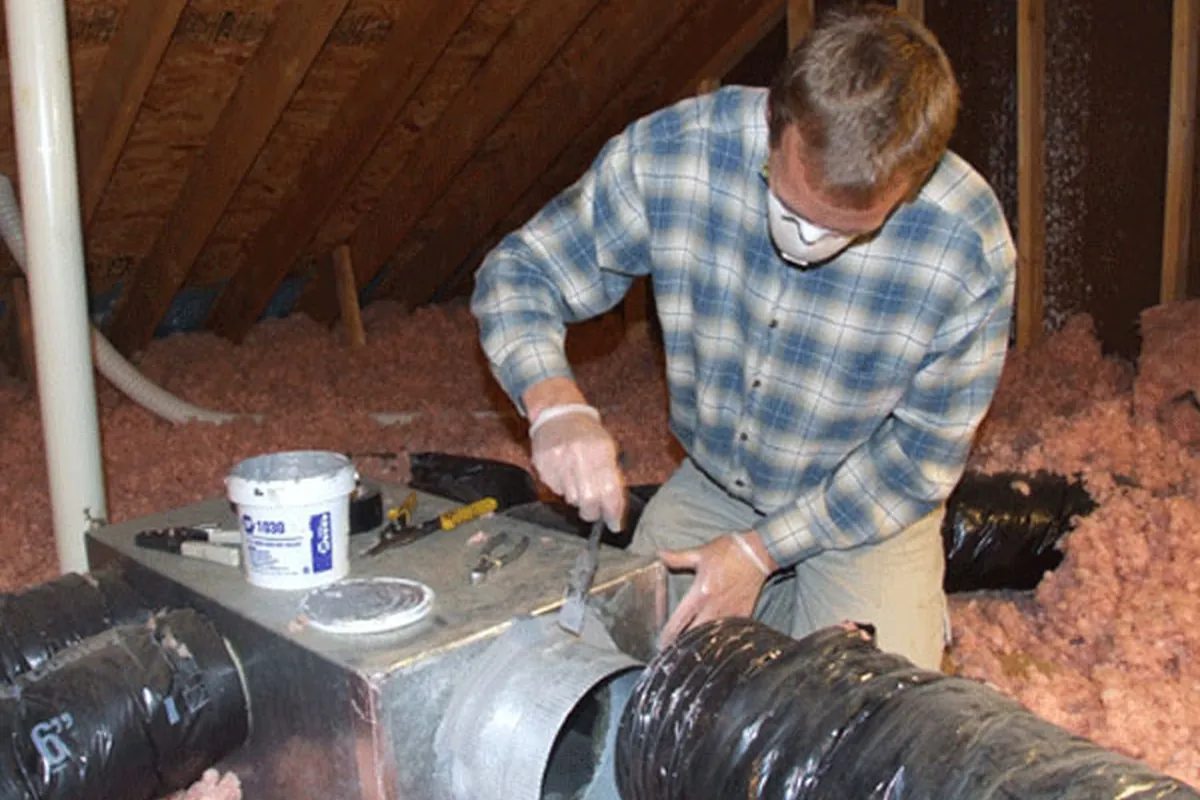
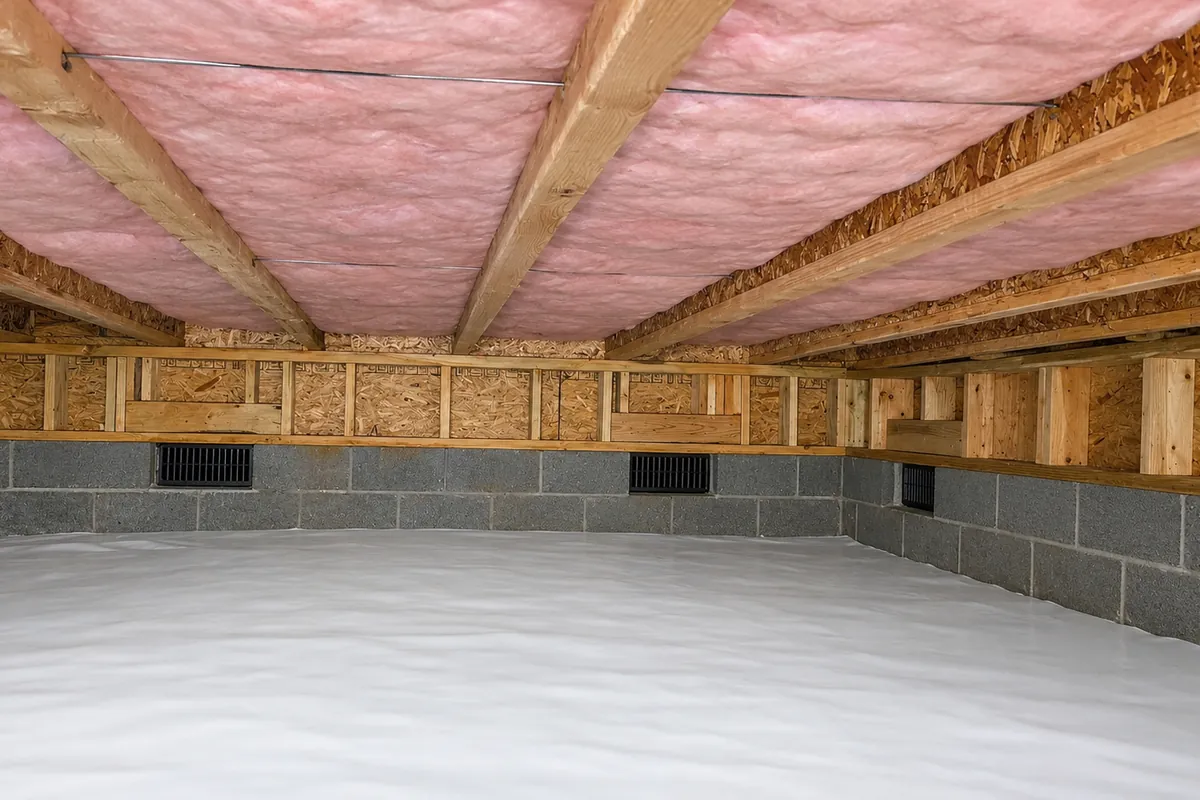
These are the same improvements that fix the hot bonus room, the drafty first floor in January and the air handler that never seems to shut off. Air sealing after a blower door diagnosis and an attic top-up from a thin R-19 to a full R-49 are the two changes we see move a Triangle house the most, and the program’s own savings rules are built around exactly that combination.
How much does the HOMES rebate pay?
HOMES is based on modeled whole-home energy savings. The approved package of improvements has to model out to at least 20% savings, and the rebate scales with both the modeled savings and your income tier. For a single-family home:
| Modeled whole-home savings | Below 80% AMI | 80–150% AMI |
|---|---|---|
| 20–34% | 100% of eligible cost, up to $16,000 | 50% of eligible cost, up to $2,000 |
| 35% or more | 100% of eligible cost, up to $16,000 | 50% of eligible cost, up to $4,000 |
Two things to notice. First, the below-80% tier is generous enough that a full attic-plus-ducts project on a typical Triangle house can fit under the cap with room to spare. Second, in the 80–150% tier the modeled savings matter: a project that reaches 35% modeled savings doubles the cap. That is one reason it usually makes sense to bundle air sealing, insulation and duct sealing into one approved project rather than doing them piecemeal.
Who qualifies in Wake County?
Eligibility is based on household income compared with the Area Median Income limit published for your county and household size. That limit is a published figure for each county and household size, not simply the county’s median income.
- Below 80% of AMI: 100% of eligible HOMES project cost, up to $16,000.
- 80–150% of AMI: 50% of eligible HOMES project cost, up to $2,000 for 20–34% modeled savings or up to $4,000 for 35% or greater.
- Above 150% of AMI: not currently eligible for Energy Saver NC income-qualified rebates.
The part that surprises people is how high the 150% line sits. This is not a program only for very low incomes.
Many Wake County families qualify. A four-person household earning under $198,450 may qualify for 50% of eligible project costs. Under $105,850, that can rise to 100% of eligible project costs, up to $16,000. Final eligibility is determined by Energy Saver North Carolina.
So a four-person household in Cary or Fuquay-Varina earning $150,000, or even $190,000, may still fall inside the published income range. Enrollment in certain income-qualified programs such as Medicaid or LIEAP can establish categorical eligibility without separate income documentation, though the program still reviews and approves the project itself. Renters can participate with the property owner’s sign-off. Multifamily buildings are not covered yet. The full Wake County household-size table, from the program’s current 2026 income summary, is on our Energy Saver NC rebates and Wake County income limits page.
What the math looks like on a real-sized project
Program rules are abstract until you put a number on them. Take a made-up but realistic project: attic air sealing, an attic insulation top-up and duct sealing on a Wake County house, quoted at $7,000 before any rebate. This is an illustration only, not a quote, and the program decides eligibility, scope and savings, but it shows how the tiers change what a homeowner actually pays.
Notice that in the middle row the rebate is $3,500 rather than $4,000. The program pays 50% of the eligible cost, and the $4,000 figure is a ceiling, not a guarantee. Likewise, the $16,000 in the top row is a ceiling; a $7,000 project is simply covered in full. Larger multi-measure projects that also add crawl space insulation are where the higher caps start to matter.
What happens from first call to finished job
The most important thing to understand about Energy Saver NC is the order of operations. The rebate is reserved before any qualifying work starts. It is not something a contractor files for after the job is done, and if someone asks you to pay full price and apply later, that is not how the program works.
- You contact a registered contractor. Peak Energy is registered, and we will tell you in one conversation whether your house has a project worth pursuing.
- Income eligibility is verified through Energy Saver NC.
- The home receives the required free HOMES home energy assessment. The program provides this at no cost to you; on some projects it is done by the program’s own assessor.
- You review the modeled improvements and the contractor’s quote with the rebate shown on it.
- The contractor submits the project scope to Energy Saver NC. The program approves it and reserves the rebate.
- The approved work is completed.
- The contractor submits the final invoice, photos and completion documents, and the program pays the approved rebate to the contractor. You pay the remaining balance.
Why air sealing comes before insulation
Energy Saver NC’s program requirements call for air sealing to be addressed before insulation is installed. That matches what we see in the field. Blowing new insulation over an attic floor full of open top plates, unsealed can lights and plumbing chases leaves most of the leakage in place, and the insulation just hides it.
Peak Energy uses blower door testing and thermal imaging to find the leaks that matter before or during the approved air sealing work. In Triangle homes the usual suspects are attic penetrations, top plates, recessed lights, rim joists and the floor penetrations above a crawl space. One clarification: the program’s free HOMES assessment is required and our own home energy audit does not replace it. Our diagnostics supplement the process and help us target the work.
Does Energy Saver NC cover duct sealing?
Yes, when it is part of an approved project. Ductwork in a hot attic or a vented crawl space is one of the biggest energy losses in a Triangle house, and duct sealing and duct insulation to R-8 are listed weatherization measures in the program requirements. Peak Energy can run duct leakage testing when the scope calls for it, and duct work often pairs with attic insulation or crawl space insulation in the same project because the ducts run through the spaces being improved. Duct sealing lives under HOMES weatherization; it is not a HEAR category.
Does crawl space encapsulation qualify for Energy Saver NC?
Not automatically, and this is where we see the most confusion. A full crawl space encapsulation in the Triangle seals the foundation vents, runs a heavy vapor barrier across the floor and up the walls, insulates the space and usually adds a dehumidifier. It averages an estimated $7,500–$15,000 depending on the size of the crawl space and what it needs. Only part of that work lines up with the HOMES program.
Certain portions of a crawl space project, including qualifying insulation, air sealing and moisture control materials, may be eligible when they are included in the Energy Saver NC approved HOMES project scope. That typically means the crawl space insulation, air sealing at the rim joists, vents and floor penetrations, and the vapor barrier that controls ground moisture. Dehumidifiers, drainage, sump pumps, mold remediation, structural repairs and other encapsulation components should not be assumed to be rebate eligible unless they are specifically approved as part of the project.
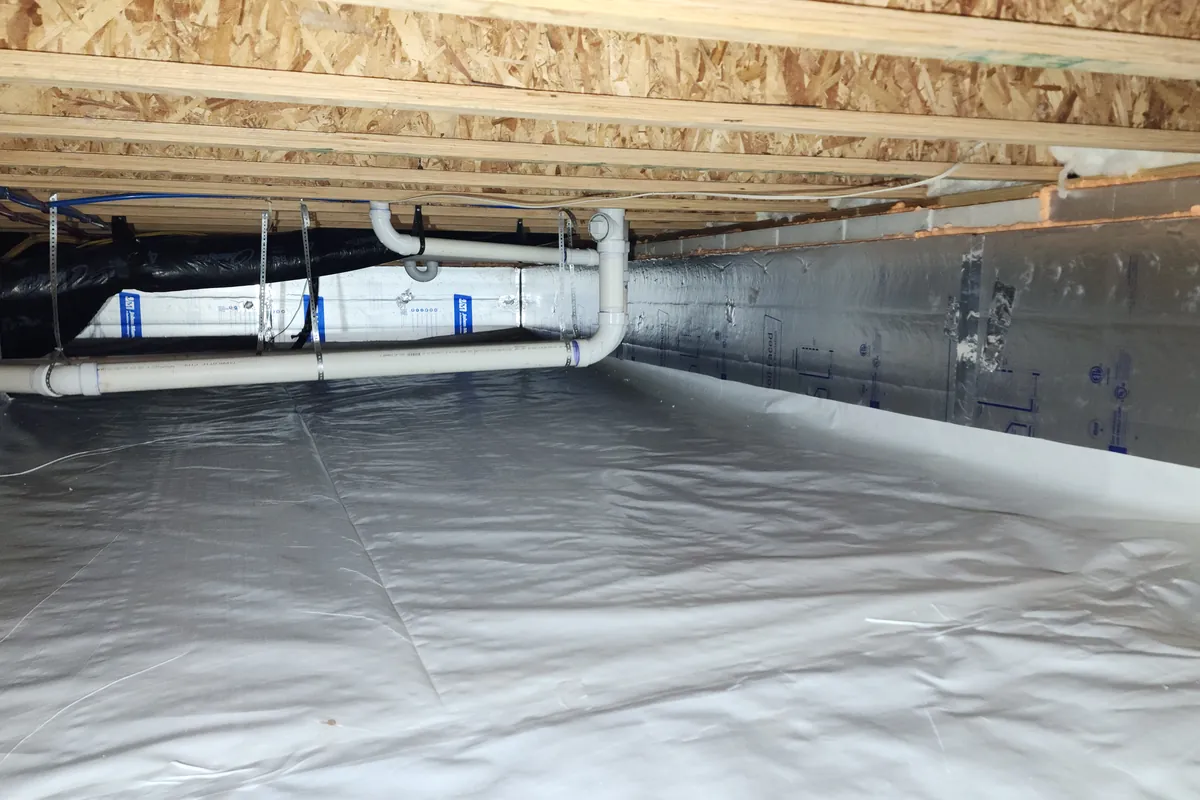
When we scope an encapsulation for a household in the program, we separate the portions that fit the approved HOMES scope from the portions that do not, so the quote is clear about what the rebate applies to. On a lot of Wake County houses with a vented crawl space over red clay, the full sealed crawl space is still the right call for humidity and durability reasons; the rebate simply covers the envelope portion of it. If you are weighing that decision, our sealed vs. vented crawl space guide covers the building science.
What about HEAR and heat pumps?
HEAR pays set amounts on specific electrification and appliance upgrades, such as heat pumps, heat pump water heaters, electrical panels and wiring, with a $14,000 cap per home. HEAR also carries a rebate of up to $1,600 toward insulation, air sealing and ventilation, so there is some HEAR money for air sealing too, though for the insulation and air-sealing work Peak Energy does, HOMES is usually the larger and more flexible path. The heat pump and appliance rebates are real money for the right house, and they are outside what Peak Energy installs. One address cannot collect from both programs for the same upgrade.
HEAR rules changed September 1, 2026. HEAR rebates can no longer be used to replace fossil-fuel appliances with electric ones, electric-to-electric upgrades are now allowed, and insulation and air sealing may be required alongside a qualifying HEAR heat pump project. Confirm current rules on the official Energy Saver NC HEAR updates page.
For HVAC upgrades such as heat pumps, we recommend going directly to Superior Heating and Cooling. Contact us and we can put you in touch with them if needed.
Three things that trip people up
Work done before approval does not qualify. Generally, a project needs Energy Saver NC approval before work begins. HOMES has limited federal retroactivity provisions for certain older projects, but do not assume last year’s insulation job qualifies. HEAR is not retroactive at all.
Only registered contractors count. Self-installed projects do not qualify, and neither does work from a company that never registered with the program. Ask any contractor quoting rebate work to confirm their registration.
Eligibility is per household, not per neighborhood. Your neighbor qualifying at 100% does not mean you will, and vice versa. Income tier, household size and the modeled savings on your specific house set your number. What Peak Energy can tell you up front is whether the house has a project worth pursuing and what it would likely include.
How to get started with Peak Energy
Peak Energy, Inc. in Holly Springs, NC is a registered Energy Saver NC contractor serving Wake, Johnston, Harnett, Durham, Orange, Chatham and Lee counties for rebate projects. We work in Triangle attics and crawl spaces every week, so we know what the improvements on a given house should be, and we help manage the program paperwork so the rebate shows up on the quote instead of becoming your homework.
The simplest first step is a call or text to (919) 567-5329. Tell us the age of the house, the rooms that give you trouble and roughly where your household lands on the income table, and we will tell you straight whether a HOMES project makes sense. If you would rather start with a diagnosis, a home energy audit with a blower door test and thermal imaging shows where the house actually leaks. If a full crawl space fix is on your mind, the encapsulation section above explains which portions of that work may fit an approved HOMES scope.
FAQ
How do I apply for Energy Saver NC HOMES rebates?
For HOMES, income eligibility is verified first and the home receives the required free home energy assessment. After you choose a Registered Contractor and approve a quote, the project is submitted to Energy Saver NC for approval and the rebate is reserved before qualifying work begins. After installation, the contractor submits final documentation such as invoices and photos, and the program pays the approved rebate to the contractor.
Can I get an Energy Saver NC rebate for work already completed?
Generally, no. New projects should receive Energy Saver NC approval before work begins. HOMES has limited federal retroactivity provisions for certain older projects that meet all program requirements, but homeowners should not assume previously completed work qualifies. HEAR rebates are not retroactive.
Is Energy Saver NC only for low-income households?
No. Eligibility runs up to 150% of Area Median Income for your county and household size. Using the program's current Wake County table, a four-person household earning under $198,450 may qualify for 50% of eligible project costs, and under $105,850 that can rise to 100% of eligible costs up to $16,000. Final eligibility is determined by Energy Saver North Carolina.
Does crawl space encapsulation qualify for Energy Saver NC?
Not automatically. Certain portions of a crawl space project, including qualifying insulation, air sealing and moisture control materials, may be eligible when they are included in the Energy Saver NC approved HOMES project scope. Dehumidifiers, drainage, sump pumps, mold remediation and structural repairs should not be assumed to be rebate eligible unless specifically approved.
What changed with HEAR on September 1, 2026?
Effective September 1, 2026, HEAR rebates can no longer be used for projects that replace fossil-fuel appliances with electric appliances, electric-to-electric upgrades are now allowed, and insulation and air-sealing improvements may be required alongside a qualifying HEAR heat-pump project. See the official Energy Saver NC HEAR updates page for current rules.
How long will Energy Saver NC funding last?
The program is expected to run until 2031 or until the funds are used up, whichever comes first. Rebates are first-come, first-served, so a qualified household with a project in mind has a reason to move sooner rather than later.
Do Energy Saver NC rebates count as taxable income?
According to the program's own FAQ, DOE Home Energy Rebates are treated as a reduction in the purchase price, not as income, so they are not reported as income on a tax return. For how that applies to your situation, ask a tax professional.
Official sources
Program rules in this article come from the official Energy Saver North Carolina publications:
- Energy Saver NC HOMES program page
- Energy Saver NC Program Requirements (PDF)
- Energy Saver NC Frequently Asked Questions
- Energy Saver NC Contractor FAQ
- Energy Saver NC HEAR updates and program changes
- Energy Saver NC AMI Income Summary (PDF)
Program information reviewed September 2, 2026. Energy Saver NC rebate amounts, income thresholds and program requirements may change. Final income eligibility, approved improvements and rebate amounts are determined by Energy Saver North Carolina. The $7,000 project example above is an illustration, not a quote.
Find out what your house qualifies for
Wondering if a rebate covers your insulation project?
Peak Energy is a registered Energy Saver NC contractor. We will look at the house, tell you straight what qualifies, and show the rebate on the quote. Serving Wake, Johnston, Harnett, Durham, Orange, Chatham and Lee counties.
Based in Holly Springs, serving the Triangle and the counties just south of it.