Table of Contents
Key takeaway: We aim for about 45–50% RH as the setpoint in sealed crawl spaces, keeping the space between roughly 45–55% year-round. A vented crawl space in the Triangle cannot hold that range on its own, because outdoor summer humidity runs 70–90% and moves straight through the foundation vents. Getting into the target range takes sealing the vents and adding a properly sized dehumidifier.
Late July is when Peak Energy, Inc. gets the most calls from homeowners who bought a $20 hygrometer, stuck it in the crawl space, and did not like the number staring back at them. The question that follows is almost always the same: what should this actually read?
The Target Range: 45–55% Relative Humidity
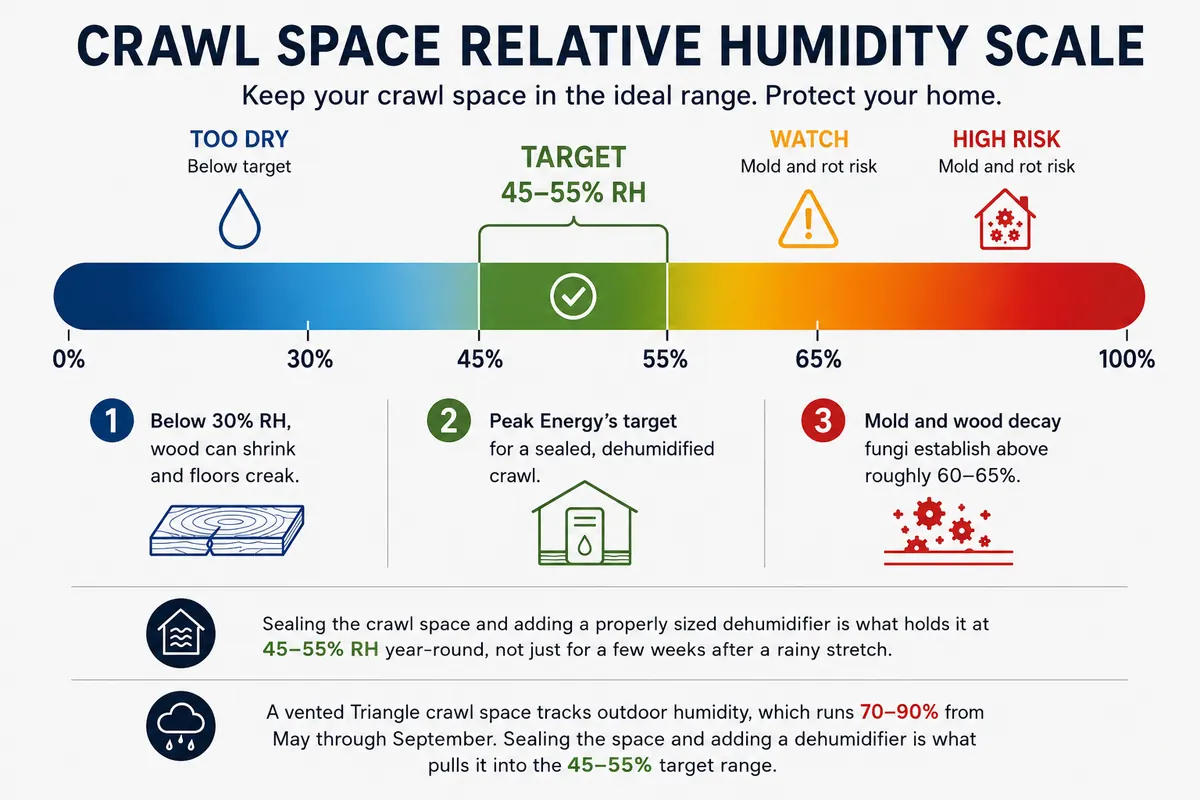
We aim for about 45–50% RH as the setpoint on sealed crawl space dehumidifiers, which keeps the space in a practical 45–55% band year-round. That range keeps wood framing, subfloor, and insulation dry enough to resist mold and rot, without running so dry that wood shrinks and floors start to creak. It is the same working band used across Peak Energy’s own encapsulation and dehumidifier installs in Wake County, with the unit’s setpoint dialed toward the lower half of that band rather than treating 55% as equally ideal.
Below 45%, there is nothing urgent to fix. Above 55%, the risk climbs the longer it stays there. 60% is the hard upper limit: sustained readings above it are where mold and wood-decay fungi can establish themselves on framing, and 65–70% is the high-risk zone, where that growth is close to guaranteed over time.
Why 45–55% and Not Some Other Number
The range is not an arbitrary round number. Treat 60% as the hard upper limit: mold and wood-decay fungi need sustained moisture to establish themselves, and most species need surface relative humidity above roughly that point to get started. Give that moisture months to sit, as a Triangle summer will, and 65–70% is the high-risk zone, a near-guarantee of visible growth on floor joists and subfloor. Staying in the 45–55% band, with the dehumidifier setpoint closer to 45–50%, keeps a meaningful buffer under that threshold, even during a stretch of especially humid weather.
The lower bound matters too, just less urgently. Well below 30% RH for long stretches can dry out wood enough to cause minor shrinkage and creaks, especially in already dry houses, showing up as squeaky floors, hairline gaps at baseboards, or drywall seams that crack upstairs. This is uncommon in a vented Triangle crawl space, where the bigger problem is almost always too much moisture rather than too little, and it is rare even in a properly sized sealed system. It becomes a real consideration only in a sealed crawl space running an oversized dehumidifier that strips out more moisture than the space needs, which is exactly why Peak Energy sets units toward a 45–50% setpoint instead of chasing the lowest reading possible.
Wood is not the only material at stake. Fiberglass insulation loses R-value when it stays damp, metal ductwork and HVAC components corrode faster in sustained high humidity, and dust mites, which thrive above 50% RH, have an easier time in a humid crawl space that shares air with the living space above it.
How to Measure Your Crawl Space’s Humidity
A basic digital hygrometer, the kind sold for under $20 at most hardware stores, gives a usable reading. Place it near the center of the crawl space rather than right next to a vent, away from standing water or a sump pump discharge, and give it a few minutes to stabilize before reading it. Checking it at the same time of day across a few visits tells you more than a single reading, since humidity in a vented crawl space swings with the weather outside.
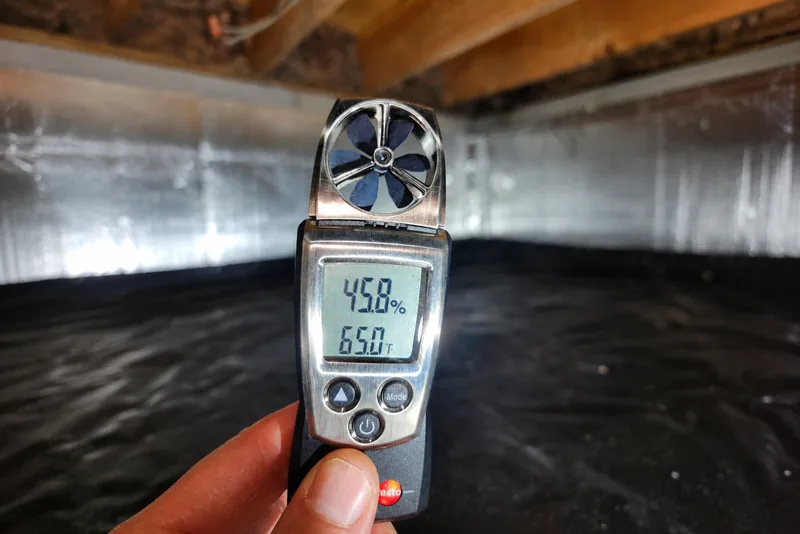
For a more precise reading tied to your specific home, a home energy audit includes a crawl space assessment with a calibrated moisture meter, along with a broader look at where air is moving through the house. An audit in the Triangle runs an estimated $475–$650+.
What a Vented Crawl Space Runs in the Triangle
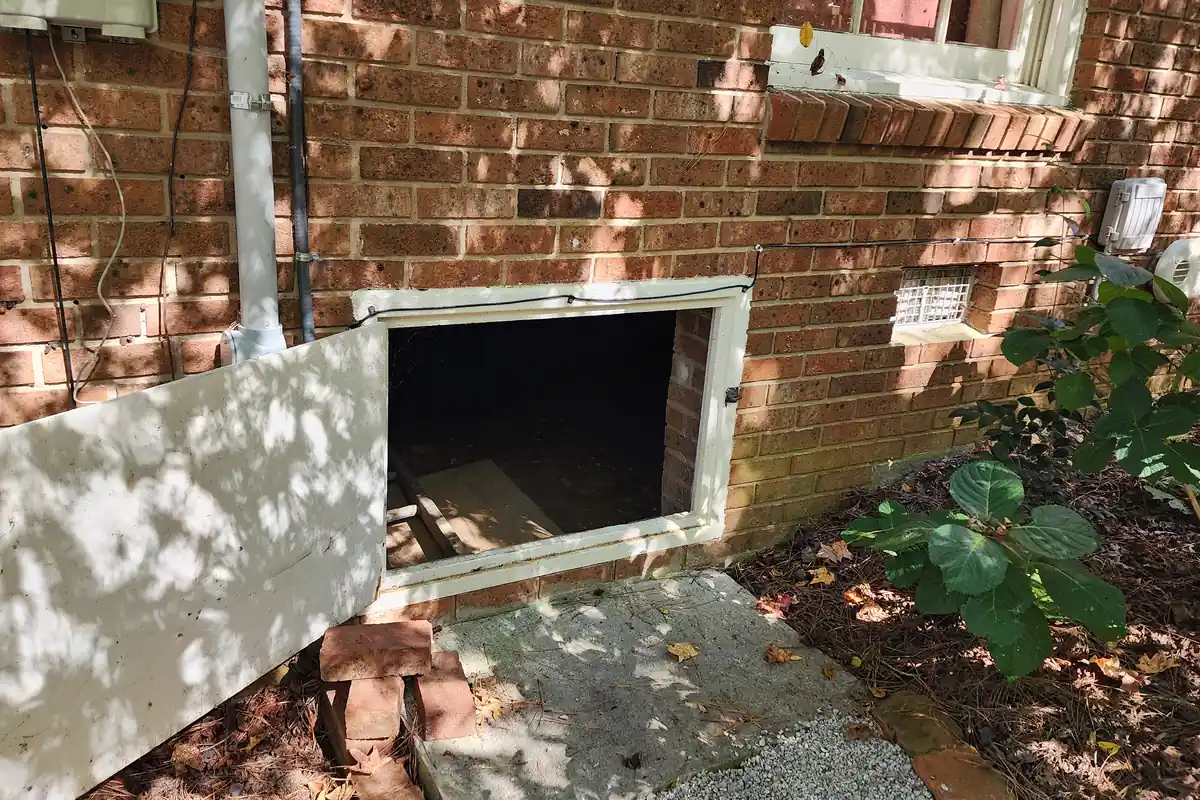
Most homes in Holly Springs, Fuquay-Varina, Apex, Cary, and Raleigh sit over a vented crawl space, which by code and by design has open foundation vents connecting it to outdoor air. That design assumption dates to a time before building science better understood how humid Southeastern summers actually behave, and it means the crawl space humidity level tracks the outdoors closely rather than holding any controlled target.
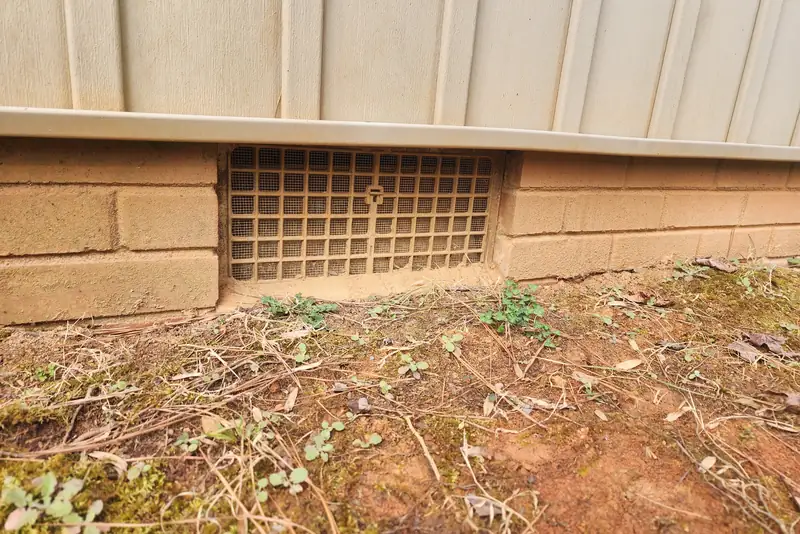
Outdoor relative humidity in the Piedmont commonly runs 70–90% from May through September. Every open vent like the one above is a direct path for that air into the crawl space, and Piedmont clay soil, which drains slowly and holds moisture against the foundation, adds ground moisture on top of it. A vented crawl space in July is rarely reading anywhere close to 45–55%. Readings of 75% or higher are common during the wettest stretches, no matter how new or well-maintained the foundation looks.
Getting a Vented Crawl Space Into the Target Range
Sealing the vents alone does not solve the problem. A sealed space with no mechanical humidity control can trap moisture and run higher than a vented one, since there is no longer a path for it to escape on its own. NC code recognizes this: a closed crawl space requires both a vapor barrier and a means of conditioning the space.
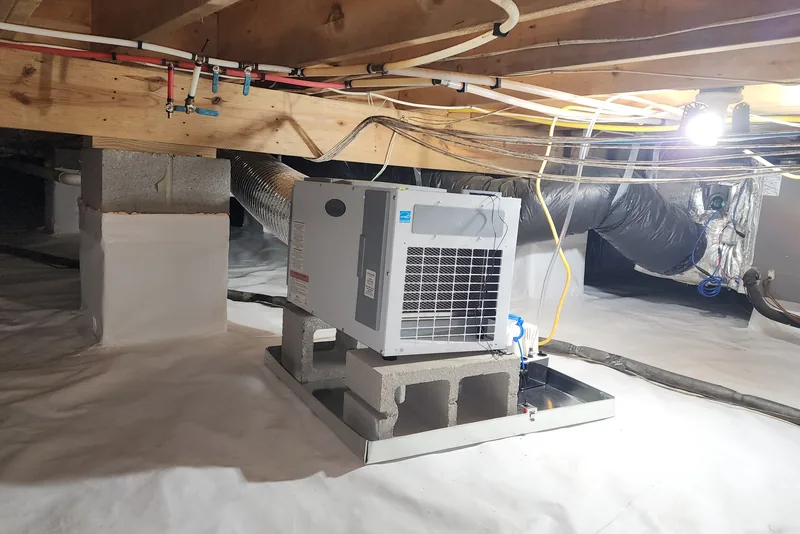
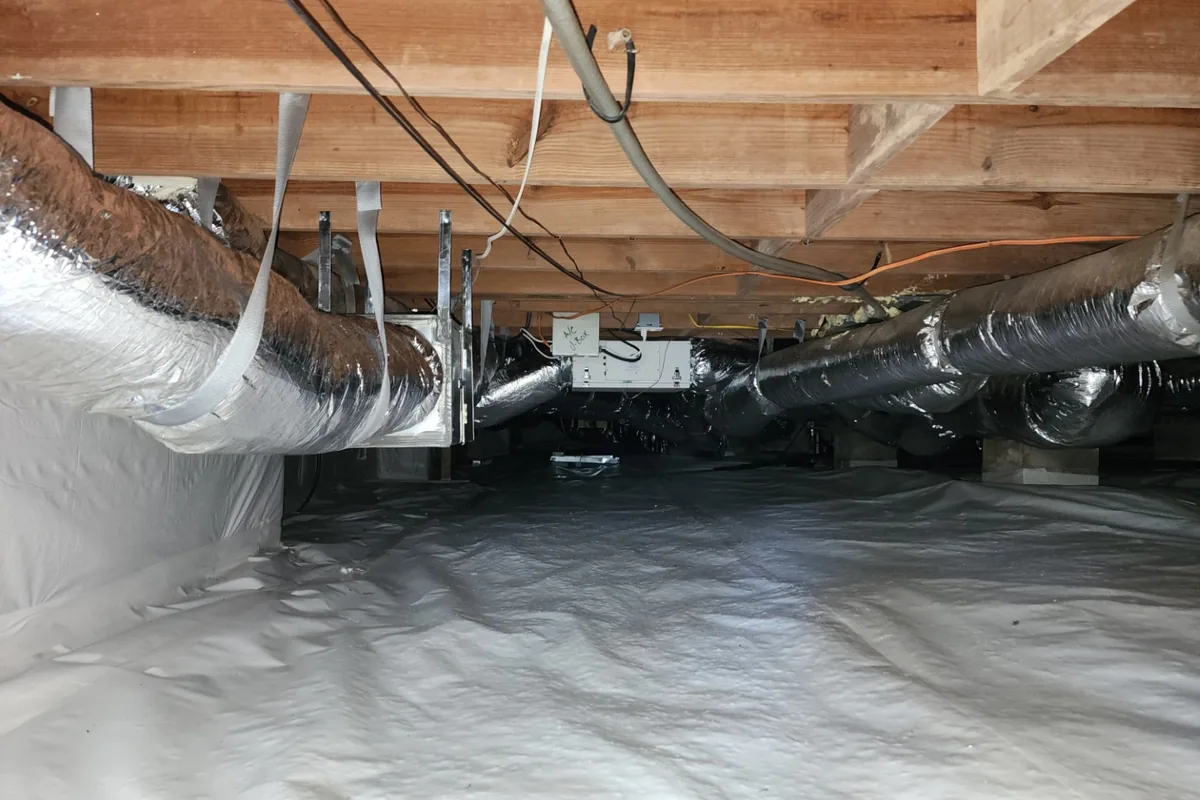
The combination that reliably holds 45–55% RH is crawl space encapsulation paired with a right-sized crawl space dehumidifier. Encapsulation closes the foundation vents and lines the floor and walls with a heavy vapor barrier, cutting off the main path outdoor humidity uses to get in. A full encapsulation averages an estimated $7,500–$15,000, depending on the size of the crawl space and scope of work, including drainage and existing moisture conditions. Where a full encapsulation is not the right fit yet, a vapor barrier alone covers ground moisture at a lower cost, though it does not close the vents the way full encapsulation does.
With the space sealed, a dehumidifier sized to the square footage of the crawl space holds it in the target range and keeps it there through the humid months instead of just after a dry stretch. Installation typically runs an estimated $3,000–$5,000. Sizing matters here. An undersized unit runs constantly and still cannot keep up in August; an oversized one can pull the space below 40% RH and dry out framing unnecessarily. Peak Energy sizes each dehumidifier to the specific crawl space rather than installing one default unit across every job.
Signs Your Crawl Space Has Been Running Too High for Too Long
A single high reading is not an emergency. A pattern of them is worth acting on. Watch for these together:
- A musty smell in the house, especially near the floor or when the HVAC system kicks on
- Visible white or gray growth on floor joists or the underside of the subfloor
- Sagging or wet-looking insulation batts pulling away from the subfloor
- Floors that feel cool or slightly tacky even when the thermostat reads comfortable
- Condensation on ductwork or metal fittings inside the crawl space
Two or more of these usually means the crawl space has been sitting well above 55% RH for a while, not just during one rainy week. Our guide on what a musty smell in the house means covers how that specific symptom connects back to crawl space humidity, and our post on crawl space mold remediation covers what to do once visible growth is already present. Spring is also when a crawl space’s humidity level typically starts climbing for the year. Our crawl space humidity in spring post covers when to check yours before summer conditions peak.
Frequently Asked Questions
What humidity level is too high year-round?
60% is the hard upper limit: sustained relative humidity above that point is where mold and wood-decay fungi start to find enough moisture to grow on framing and subfloor. 65–70% is the high-risk zone, where that growth becomes a near certainty over time, not just a possibility. The working range for a well-managed crawl space is 45–55% RH, with the dehumidifier setpoint closer to 45–50%, which leaves a comfortable margin below the point where mold becomes likely.
Can a crawl space be too dry?
Yes, though it is rare in the Triangle without mechanical help. Well below 30% RH for long stretches can dry out wood enough to cause minor shrinkage and creaks, especially in already dry houses, showing up as squeaky floors, small gaps at trim, or cracked drywall seams upstairs. This mostly happens in sealed crawl spaces with an oversized dehumidifier running year-round rather than a properly sized one, which is why sizing the equipment to the space matters as much as sealing it.
Why does my vented crawl space run higher than 55% RH?
A vented crawl space has open foundation vents by design, so it stays close to outdoor humidity rather than holding a controlled target. In the Triangle, outdoor relative humidity commonly runs 70–90% from May through September, and that air moves straight into the crawl space through the vents. Without sealing the vents and adding a dehumidifier, a vented crawl space cannot hold 45–55% RH through a Piedmont summer no matter how new or well-built the house is.
How often should I check my crawl space's humidity?
For a vented crawl space, checking once each season catches the biggest swings, with extra attention in late spring as outdoor humidity climbs. For a sealed, encapsulated crawl space with a dehumidifier, most units display the current reading continuously, so a homeowner can glance at it anytime. A crawl space assessment from Peak Energy, Inc. also includes a humidity reading as part of the visit.
Find Out What Your Crawl Space Is Actually Running
Not sure if your number is a problem?
Peak Energy, Inc. provides crawl space assessments across Wake County and the Triangle, including a humidity reading and a plain explanation of what it means for your home.
Serving Holly Springs, Fuquay-Varina, Apex, Cary, Raleigh, Garner, and the broader Triangle region.