
Table of Contents
Key takeaway: A home energy audit in North Carolina uses diagnostic tools, including blower door testing, thermal imaging, and optional duct leakage testing, to pinpoint where your home loses energy and what to fix first. A thorough audit costs $475–$650+. In 2026 it also doubles as the smartest first step before an Energy Saver NC rebate project, because it tells you whether the house has work worth putting through the program.
Updated September 2, 2026 to add how an audit fits with Energy Saver NC rebates and to tighten the savings estimates.
If your Duke Energy bill has been climbing and you cannot explain why, you are not imagining it. Rates are higher than they were a few years ago, and most Wake County homeowners feel it without knowing where to start looking for the cause. A home energy audit is where you start. Not a free inspection, but a real diagnostic audit, with calibrated equipment and an on-site walkthrough of the findings.
What Is a Home Energy Audit?
A home energy audit is a systematic assessment of how your home uses and loses energy. A trained auditor examines the building envelope (walls, attic, crawl space, windows, and doors), the HVAC and duct system, and the appliances, then uses diagnostic testing to measure actual performance against benchmarks.
After testing, the auditor walks through the findings with you on-site: a prioritized discussion of what was found, what to fix first, and what it is worth. You get numbers, not guesses.
What a real audit is not: a free inspection from a contractor who walks your attic and gives you a quote. Those visits can be useful, but they rely on visual observation rather than measurement. The diagnostic data from a blower door or duct blaster tells you things a flashlight never will.
Why NC Homes Especially Benefit From Energy Audits
North Carolina’s climate is harder on homes than most homeowners realize. The Piedmont sits in IECC climate zone 4A, with hot and humid summers, mild but occasionally freezing winters, and 43–50 inches of annual rainfall. From June through September, outdoor relative humidity in Wake County runs 70–90%. That moisture does not stay outside.
The red clay soils beneath Wake County homes, predominantly the Cecil and Appling soil series, hold moisture and drain slowly. Water pools around foundations during rain events, evaporates slowly, and wicks through untreated crawl spaces. A vented crawl space, which describes the majority of homes built in the area before the mid-2000s, allows that humid air to migrate upward through the stack effect, the natural pressure difference that draws air from below and exhausts it through the top of the house.
The housing stock compounds the problem. Most Cary neighborhoods were built in the 1970s and 1980s, before modern energy codes. Holly Springs and Apex grew rapidly in the 1990s through 2010s, producing homes that are now 15–35 years old and due for a building-science checkup. Many were built with vented crawl spaces, minimal air sealing, and HVAC systems sized by guess rather than calculation.
An energy audit puts real measurements against all of this. It tells you not just that your home is leaking energy, but where, how much, and what it is worth fixing first.
What Happens During a Home Energy Audit, Step by Step
Step 1: Pre-Audit Preparation: Utility Bill Review and Homeowner Interview
Before the technician arrives, you will be asked to gather 12 months of utility bills if you have them. These reveal patterns: unusually high January heating costs, summer spikes that suggest poor envelope performance, or flat usage that rules out certain problems.
At the start of the visit, the auditor will ask about your comfort complaints: rooms that are always hot or cold, humidity problems, musty odors, high bills. This interview is not small talk. It is a diagnostic tool that tells the auditor where to pay close attention.
Before any testing begins, the auditor will also ask you to close all windows, exterior doors, and fireplace dampers, and turn off any combustion appliances that draw air. The blower door test requires a controlled pressure environment.
Step 2: Physical Walk-Through: Attic, Crawl Space, Insulation, Appliances
The walk-through follows a consistent path: exterior perimeter, then mechanical spaces, then living areas.
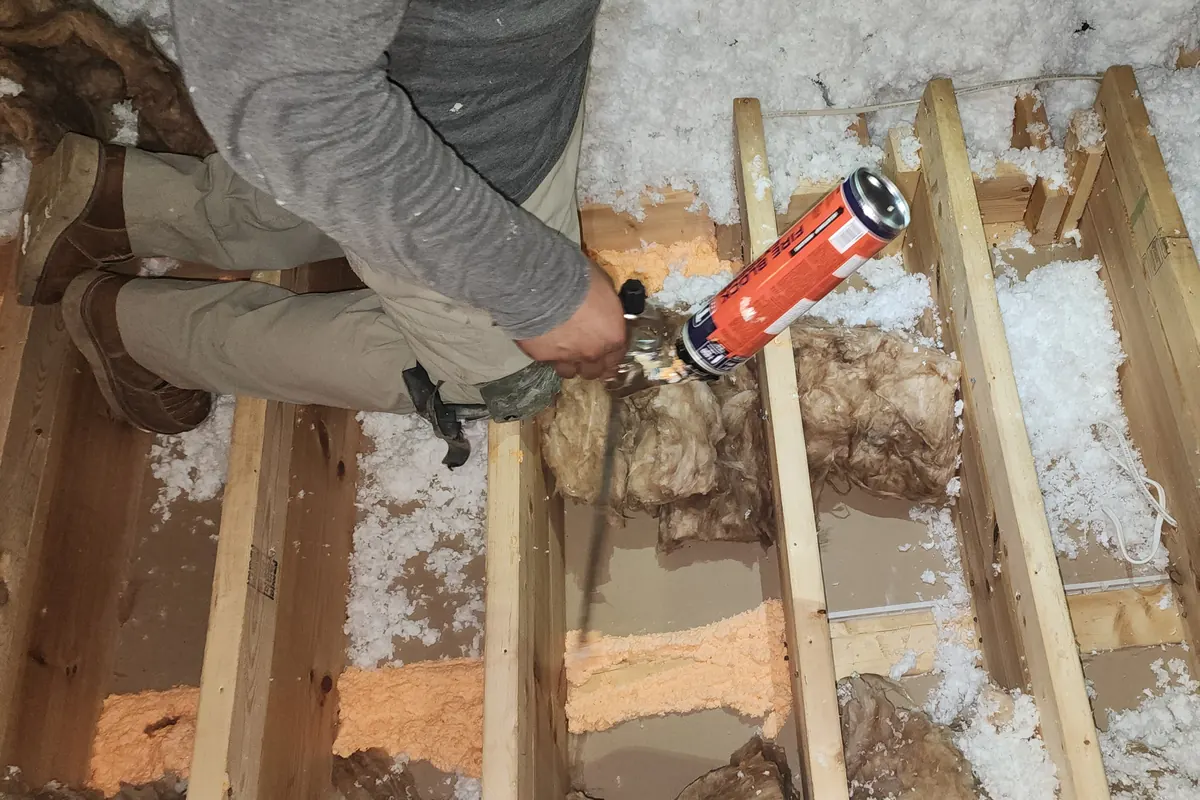
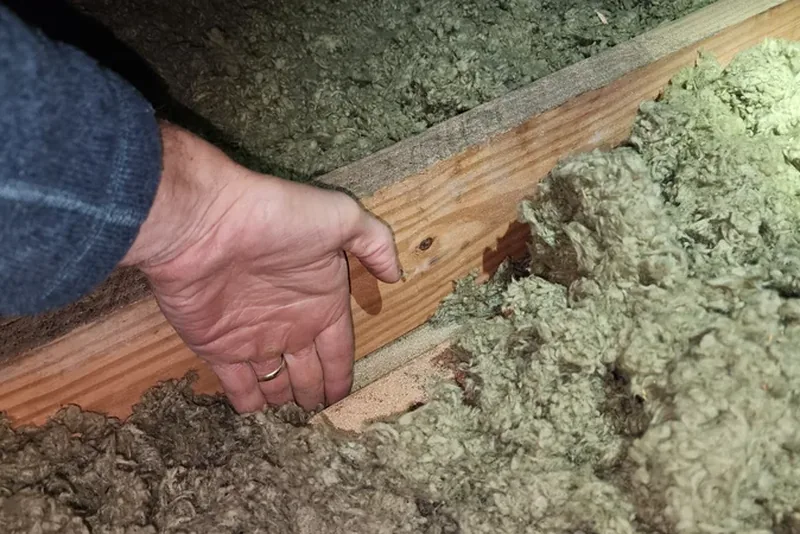
Attic: The auditor checks insulation depth and type, looks for gaps around attic hatch covers and penetrations (wiring, plumbing, light fixtures), and notes the condition of any attic ductwork. In many older Wake County homes, insulation has settled or degraded, so R-values that were once adequate may now be significantly lower. Bypasses around electrical boxes and partition walls are common sources of air leakage that will not show up in a visual inspection but show clearly on a thermal camera.
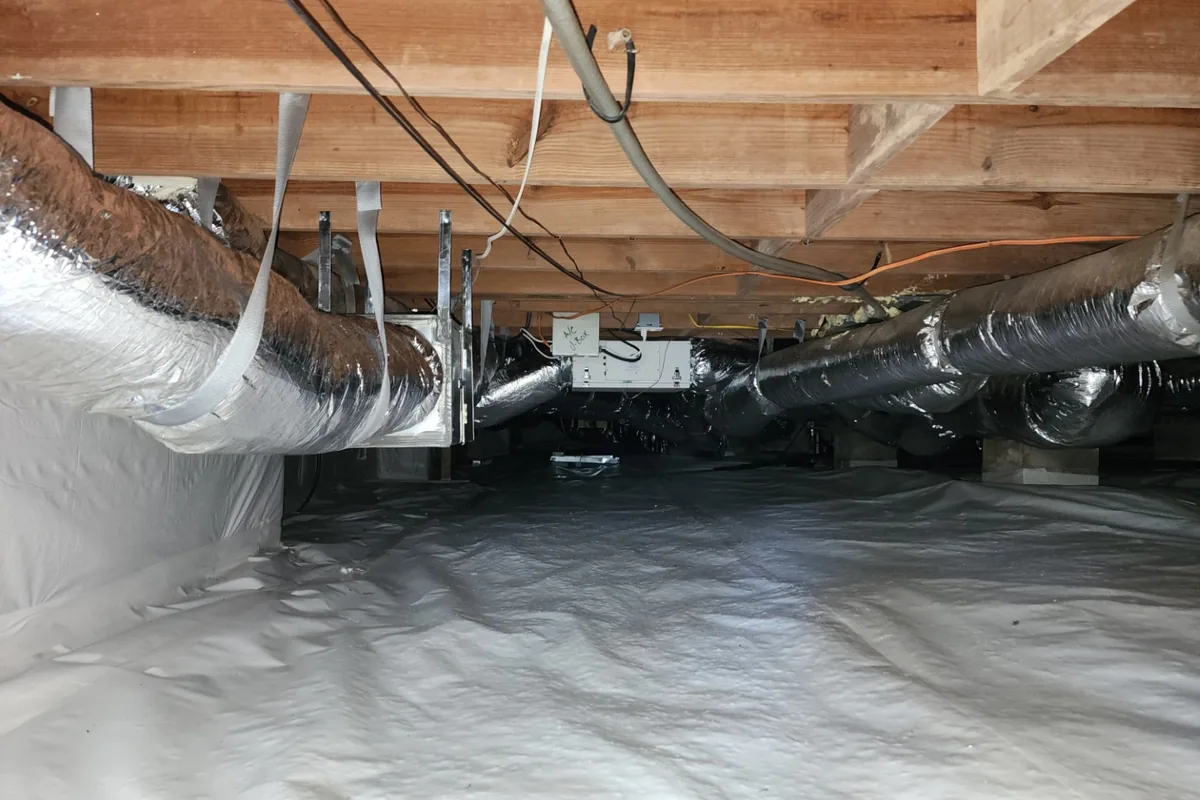
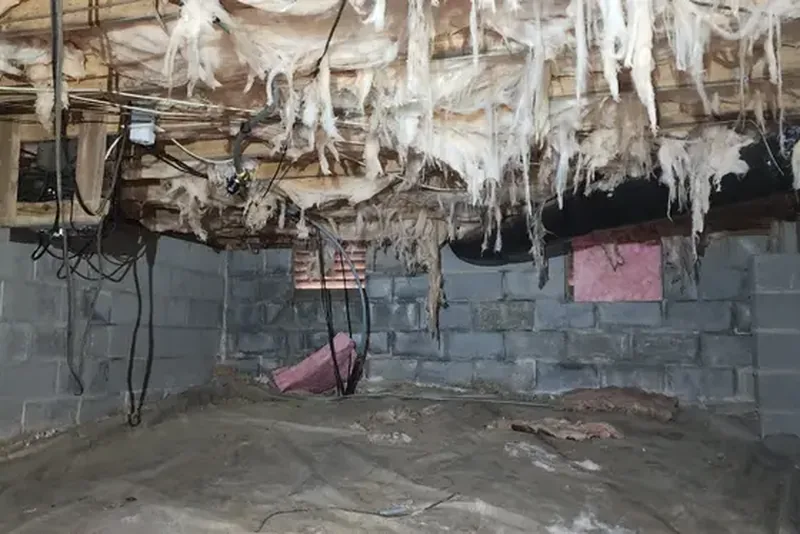
Crawl space: This is often the most revealing part of the walk-through. The auditor checks vapor barrier condition, insulation on the floor joists or foundation walls, the presence of standing water or efflorescence, and whether the crawl space is vented or sealed. Relative humidity in the crawl space is measured; above 60% contributes to mold growth, wood degradation, and elevated whole-house moisture loads. The rim joist and band board area are also inspected. They rank among the worst air sealing locations in most existing homes.
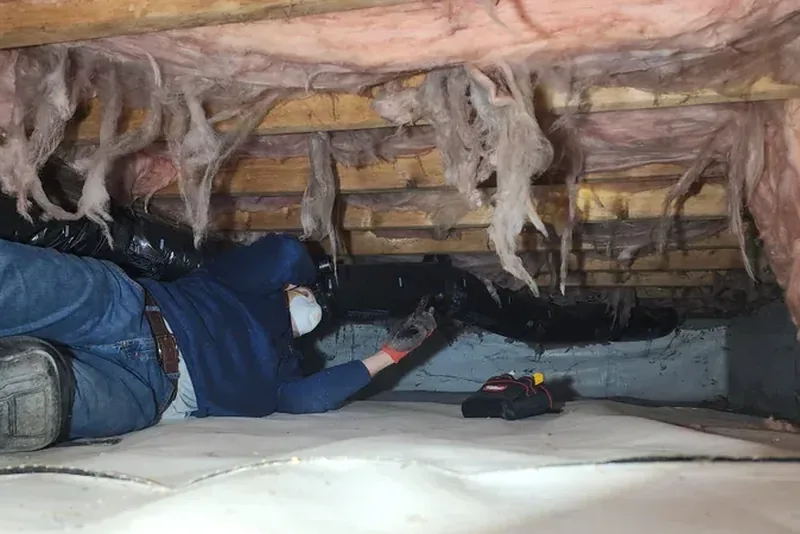
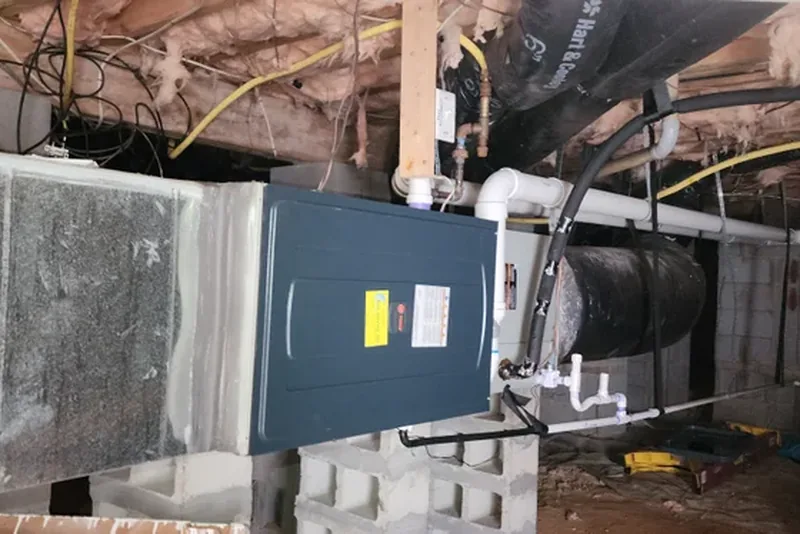
Mechanical systems: The HVAC unit, air handler, and water heater are inspected for age, condition, and combustion safety. Combustion appliances are checked for proper venting, a safety check that many audits omit.
Living areas: A room-by-room walkthrough documents window and door conditions, visible insulation gaps, and comfort complaints tied to specific areas.
Step 3: Blower Door Test: Quantifying Air Leakage
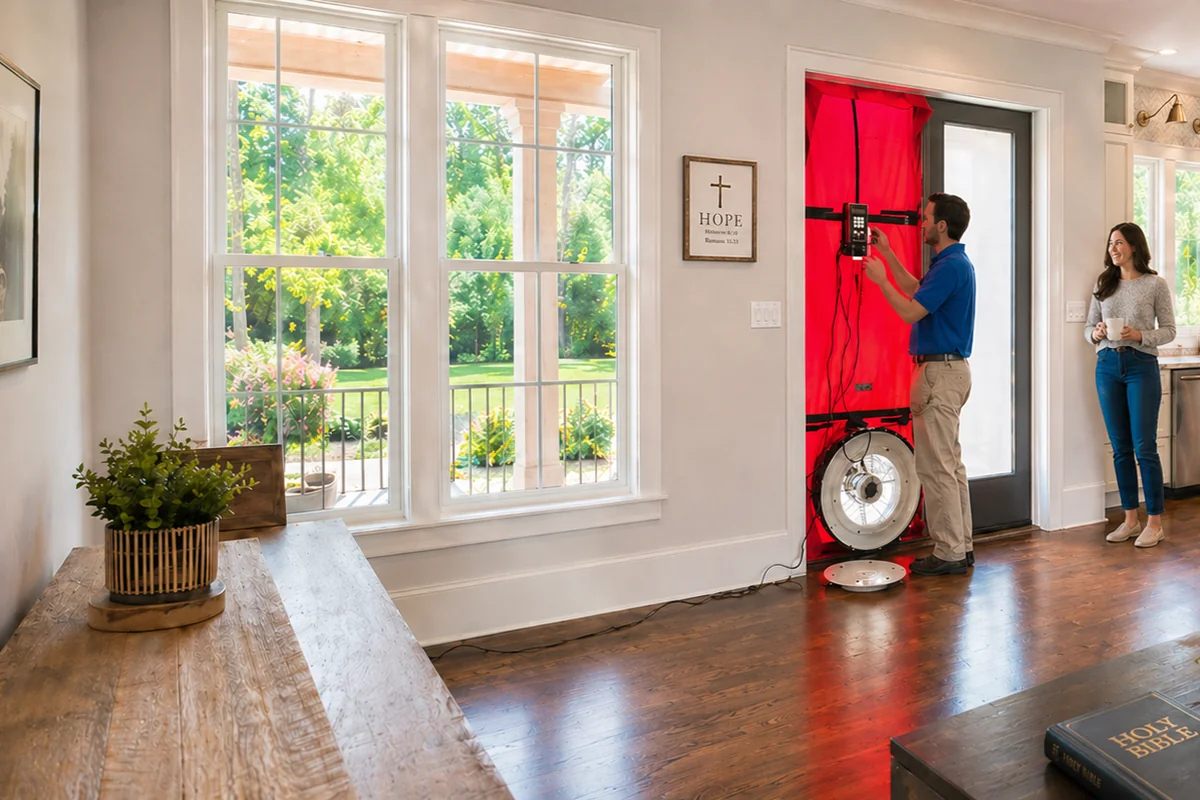
The blower door test is the quantitative core of the audit. A calibrated fan mounts in an exterior doorway and depressurizes the home to 50 pascals of pressure, about the force of a 20 mph wind pushing against every surface of the house at once.
At 50 pascals, every gap, crack, and bypass in the building envelope is amplified. The fan measures exactly how much air must flow to maintain that pressure difference, which directly tells you how leaky the house is. The result is reported in ACH50: air changes per hour at 50 pascals.
North Carolina’s energy code requires new homes to test at or below 5 ACH50 (or 0.30 CFM50 per square foot of envelope area). Most existing homes in the Triangle test in the 6–12 ACH50 range. There is no universal passing threshold for an existing house, but a result above 8 usually means there is a significant air sealing opportunity.
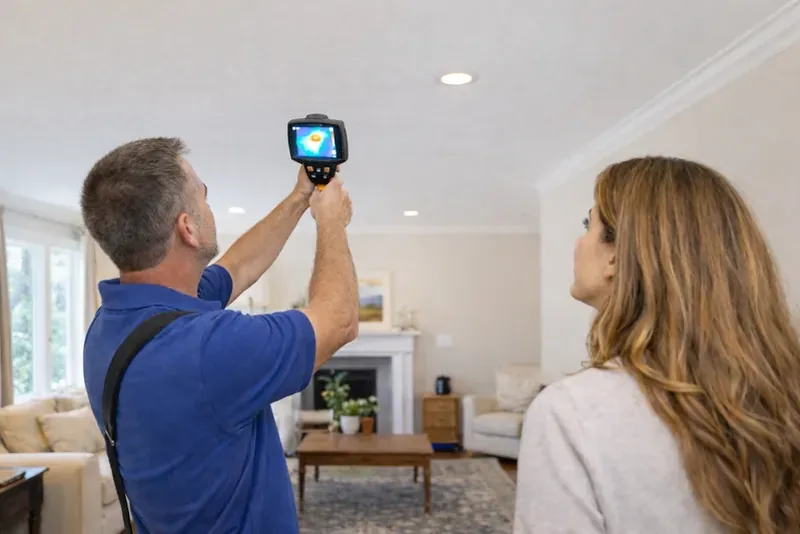
With the blower door running, the thermal imaging camera maps where that air is going. The combination is powerful: the blower door amplifies leaks and the camera makes them visible. You see exactly which areas of the attic floor, rim joist, or foundation wall are the sources of infiltration.
For more detail on how Peak Energy uses blower door testing for both existing-home diagnostics and new-construction compliance, see our blower door testing page. If you want to understand your number, our guide to reading blower door test results walks through it.
Step 4: Thermal Imaging: Mapping Heat Loss and Gain
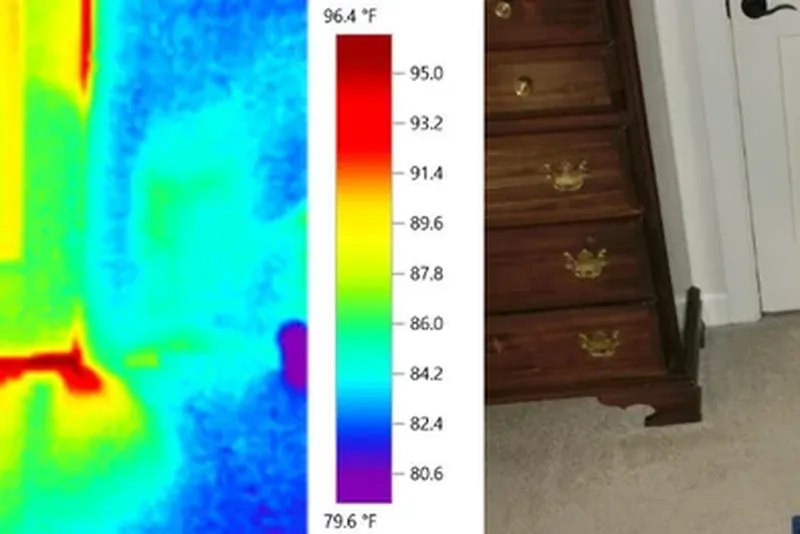
An infrared camera sees thermal radiation, and when there is a temperature difference between inside and outside (as there always is during a conditioned season), that radiation reveals the thermal map of your building envelope.
Missing insulation shows up as a cold spot in winter, a hot spot in summer. Air bypass paths, such as the gap between the top of a partition wall and the attic floor, appear as streaking temperature anomalies. Moisture intrusion shows a distinctly different thermal signature from simple heat loss, because wet materials hold temperature differently than dry ones.
During the home energy audit walk-through, the thermal camera turns a physical inspection into a data-driven map. The auditor shows you the thermal images on-site and walks through every anomaly so you can see exactly what was found and where.
Step 5: Duct Leakage Test (Optional Add-On): Measuring HVAC Delivery Efficiency
Most homes in Wake County have ductwork running through the attic or crawl space, spaces that are unconditioned in summer and winter. Any conditioned air that leaks out of the ducts before reaching the living area is wasted.
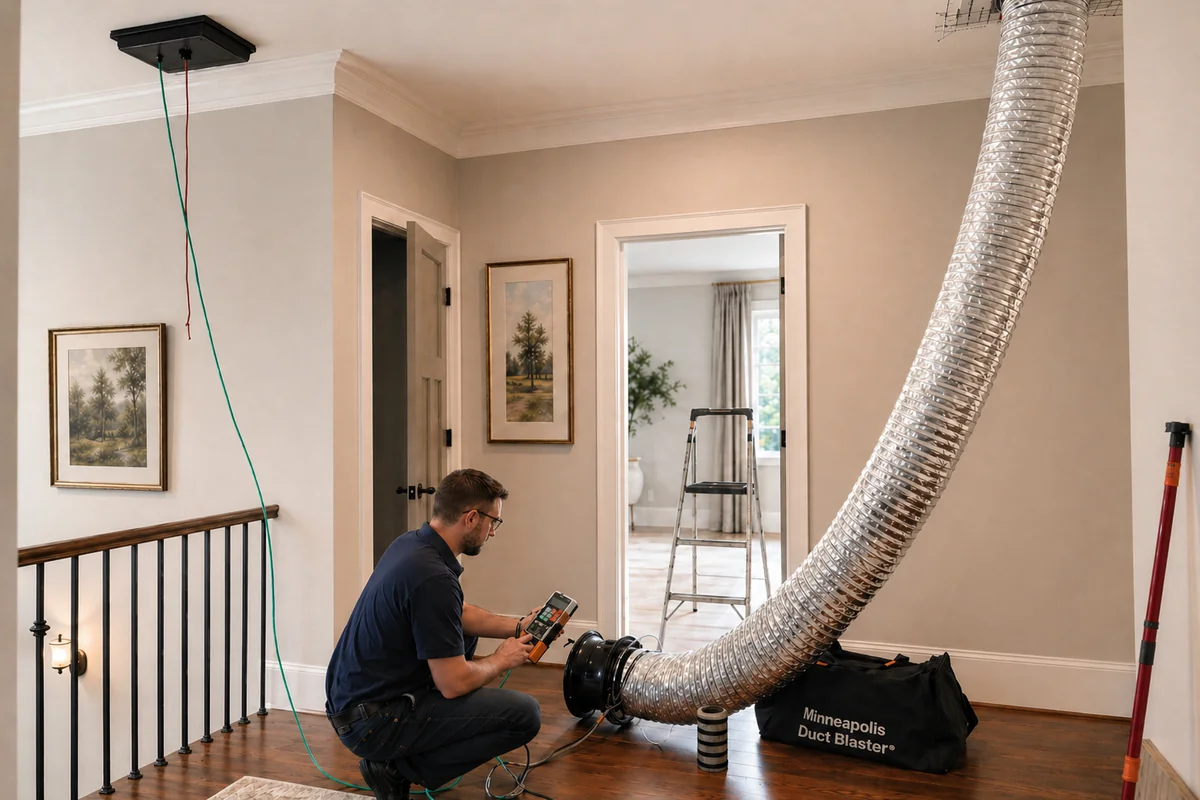
A duct blaster pressurizes the duct system, typically to 25 pascals, and measures how much air escapes. The result is expressed in CFM25 (cubic feet per minute at 25 pascals). NC code requires new construction to achieve 4 CFM25/100sf of conditioned floor area or less for duct leakage to outside. Many existing homes miss that benchmark by a wide margin.
Leaky ducts have two effects: they reduce the conditioned air delivered to rooms, and they unbalance the system, depressurizing the house and pulling unconditioned air in through the building envelope. The fix is duct sealing with mastic, not additional insulation.
Duct leakage testing is an optional add-on to the basic audit at $250 per HVAC system. It is worth adding when the ducts run through an attic or vented crawl space, or when one part of the house never gets comfortable. For builders and HVAC contractors seeking NC code compliance testing, Peak Energy offers standalone duct leakage testing for new construction and renovation projects.
Step 6: Post-Audit Discussion: Prioritized Recommendations
After testing is complete, the auditor walks through the findings with you on-site. You review the measured results (ACH50, CFM25 if tested, crawl space humidity, attic R-value, thermal images) and discuss prioritized improvements ordered by return on investment, with estimated cost ranges and projected savings for each.
This is a conversation, not a sales pitch. Some of the highest-impact improvements, such as sealing bypasses around attic penetrations or adding weatherstripping to a door, cost almost nothing. Others, like crawl space encapsulation or attic insulation upgrades, involve real investment. The walkthrough gives you the cost-benefit picture for each one so you can decide where to start.

What the Audit Reveals: Common Findings in Wake County Homes
Most audits in our service area turn up variations of the same core issues.
Air sealing deficiencies in the attic. Gaps around partition wall tops, recessed lights, plumbing and electrical penetrations, and the attic access hatch. These are invisible from the floor but show clearly on thermal imaging and account for a large share of most homes’ ACH50 reading.
Vented crawl spaces with inadequate vapor barriers. The majority of existing homes in Holly Springs, Cary, and Raleigh were built with vented crawl spaces that have either no vapor barrier or a thin poly sheet that has degraded over time. In NC’s humid climate, this is a primary contributor to elevated humidity throughout the home and increased HVAC runtime. More on the sealed vs. vented crawl space debate if you want the full building science.
Insufficient attic insulation. NC homes from the 1970s–1990s often have R-11 to R-19 insulation in the attic floor. Current recommendations for this climate zone target R-38 to R-60. Upgrading is one of the highest-return improvements available to older homes. Our attic insulation cost guide covers what a top-up runs in the Triangle.
Duct leakage. In homes with ductwork in the attic or crawl space, a meaningful share of the conditioned air the HVAC system produces can leak out before it reaches a room. Sealing those joints and transitions with mastic noticeably reduces both energy bills and humidity levels.
Humidity and moisture problems. Crawl space humidity above 60% is a contributing factor to musty odors, mold on wood framing, elevated whole-house humidity, and shortened HVAC equipment life. A crawl space dehumidifier paired with encapsulation addresses both the symptom and the source.
After improvements are made, Peak Energy offers energy monitoring to track actual performance over time, so you are not relying on your next utility bill to find out whether the work delivered.
How an Audit Fits With Energy Saver NC Rebates
This is new for 2026 and it changes the math on a lot of Wake County houses. Energy Saver North Carolina, the state’s federal Home Energy Rebates program, now pays a large share of attic insulation, air sealing, crawl space insulation and duct sealing in qualifying homes. Households below 80% of Area Median Income may receive 100% of eligible project costs up to $16,000, and households between 80% and 150% AMI may receive 50%, up to $2,000 or $4,000 depending on modeled savings. The published Wake County income limits reach well into middle-income territory.
Two things to understand about how the audit and the rebate fit together. First, the program provides its own free HOMES home energy assessment, and that assessment, not our audit, is the one the rebate is built on. Second, the project has to be approved and the rebate reserved before any work starts. What a Peak Energy audit does is tell you, before you go through the program, whether the house actually has an insulation, air sealing or duct project worth pursuing and what it would likely include. If it does, Peak Energy is a registered Energy Saver NC contractor and can help set the project up through the program from the start.
Our guide to how Energy Saver NC rebates work walks through the tiers, the process and a worked example. The Wake County income table is on our Energy Saver NC rebates page.
What to Do Before Your Home Energy Audit
A few preparation steps make the audit more accurate and the visit more efficient.
Gather 12 months of utility bills. Duke Energy’s online account portal lets you download usage history. If you do not have access, call ahead and request the data.
Make a list of comfort complaints. Note specific rooms that are too hot, too cold, or feel humid. Note any musty odors and where they are strongest.
Write down your equipment ages. If you know when the HVAC unit, water heater, or major appliances were installed, share that.
Clear access points. The auditor needs clear access to the attic hatch, crawl space entry, and mechanical equipment. Move any storage blocking those areas.
Prepare for testing conditions. On the day of the audit, close all exterior windows and doors at least an hour before the appointment. Shut fireplace dampers. Turn off any exhaust fans, range hoods, or combustion appliances.
Plan to be present. The homeowner interview at the start of the audit is one of the most valuable parts. Be there to walk through the home with the auditor. You will understand the findings better, and the auditor will be better equipped to find what matters to you.
Home Energy Audit Cost in North Carolina
A professional home energy audit in NC costs $475–$650+. That range reflects differences in home size and age. The base audit includes the utility bill review, physical walk-through, blower door test, thermal imaging, and the on-site walkthrough of findings. Duct leakage testing is an optional add-on at $250 per HVAC system, and HVAC airflow testing is $200 per system.
| Factor | Effect on Cost |
|---|---|
| Home size | Larger homes take more time; audit cost increases |
| Home age | Older homes often require more documentation |
| Add-on tests | Duct leakage ($250/system) and HVAC airflow ($200/system) are extra |
| Travel distance | Remote locations outside the primary service area may add cost |
For a fuller breakdown, see our home energy audit cost guide. Measured against the cost of guessing wrong on a $3,000–$5,000 improvement, the audit is inexpensive.
Frequently Asked Questions
How long does a home energy audit take in NC?
A thorough home energy audit takes 2–4 hours, depending on home size and age. Older homes, particularly the 1970s–1980s Cary and Raleigh homes common in Wake County, often take longer because there are more air sealing deficiencies and HVAC issues to document. Budget at least three hours for a complete audit that includes blower door testing, thermal imaging, and duct leakage testing.
Will a home energy audit tell me if my crawl space is causing problems?
Yes. A thorough audit always includes a crawl space inspection. In North Carolina, the crawl space is one of the most common sources of energy loss and indoor air quality problems. During the blower door test, the thermal camera often reveals conditioned air escaping into the crawl space, and during humid summers moisture migrating from a vented crawl space adds to the work your HVAC does. The technician will document humidity levels, vapor barrier condition, insulation gaps, and whether the space is contributing to the stack effect.
What's the difference between a home energy audit and a free inspection?
A free inspection is a sales tool: a technician walks your home with a flashlight and gives you a quote. A real home energy audit is a diagnostic process using calibrated equipment, including a blower door to measure air infiltration in ACH50, an infrared camera to map heat loss and gain across the building envelope, and optionally a duct blaster to quantify duct leakage in CFM25. After testing, the auditor walks through the findings with you on-site. The $475–$650+ cost is justified by the specificity of the findings: you know which improvements will have the biggest impact, in what order, before spending a dollar on any of them.
How much can I save after a home energy audit?
It depends on where the house starts. As rough estimates, an attic insulation top-up from R-19 to R-49 saves an estimated 10–20% on heating and cooling, and targeted air sealing after a blower door diagnosis saves an estimated 5–15%. A 1970s Cary home with original attic insulation and a vented crawl space has considerably more room to improve than a 2010s Holly Springs home built to a tighter code. The auditor discusses projected savings for each recommended improvement with you on-site so you can prioritize by payback.
Does a home energy audit help me get an Energy Saver NC rebate?
It helps you decide whether a rebate project is worth pursuing, but it does not replace the program's required assessment. Energy Saver NC provides its own free HOMES home energy assessment, and the project must be approved and the rebate reserved before work begins. Peak Energy is a registered Energy Saver NC contractor, so if the audit turns up an insulation, air sealing or duct sealing project, we can help set it up through the program.
Ready to Find Out Where Your Home Is Losing Energy?
If you are in Holly Springs, Apex, Cary, Fuquay-Varina, or anywhere in Wake County, a home energy audit from Peak Energy gives you a clear, prioritized picture of where your energy dollars are going and what to do about it. We have been serving Wake County homeowners for over 15 years.
Serving Holly Springs, Raleigh, Cary, Apex, Fuquay-Varina & the Triangle