Table of Contents
Key takeaway: A blower door test result is an ACH50 number: air changes per hour at 50 pascals. New construction in NC passes at 5.0 ACH50 or less under the 2018 NC Energy Conservation Code. Existing homes have no code threshold, but results above 8 ACH50 usually mean enough unsealed leakage to be worth fixing.
How to Read Your ACH50 Result
A blower door test produces a single number: ACH50, or air changes per hour at 50 pascals of pressure. If you have just received results from a test on a new home or an existing one, here is how to read that number, what North Carolina code requires, and what comes next if the result is higher than it should be.
The short answer for new construction in NC: 5.0 ACH50 or less passes the 2018 NC Energy Conservation Code. For existing homes, there is no code threshold, but anything above 8 ACH50 typically means the envelope has significant unsealed leakage worth addressing.
What the Test Actually Measures
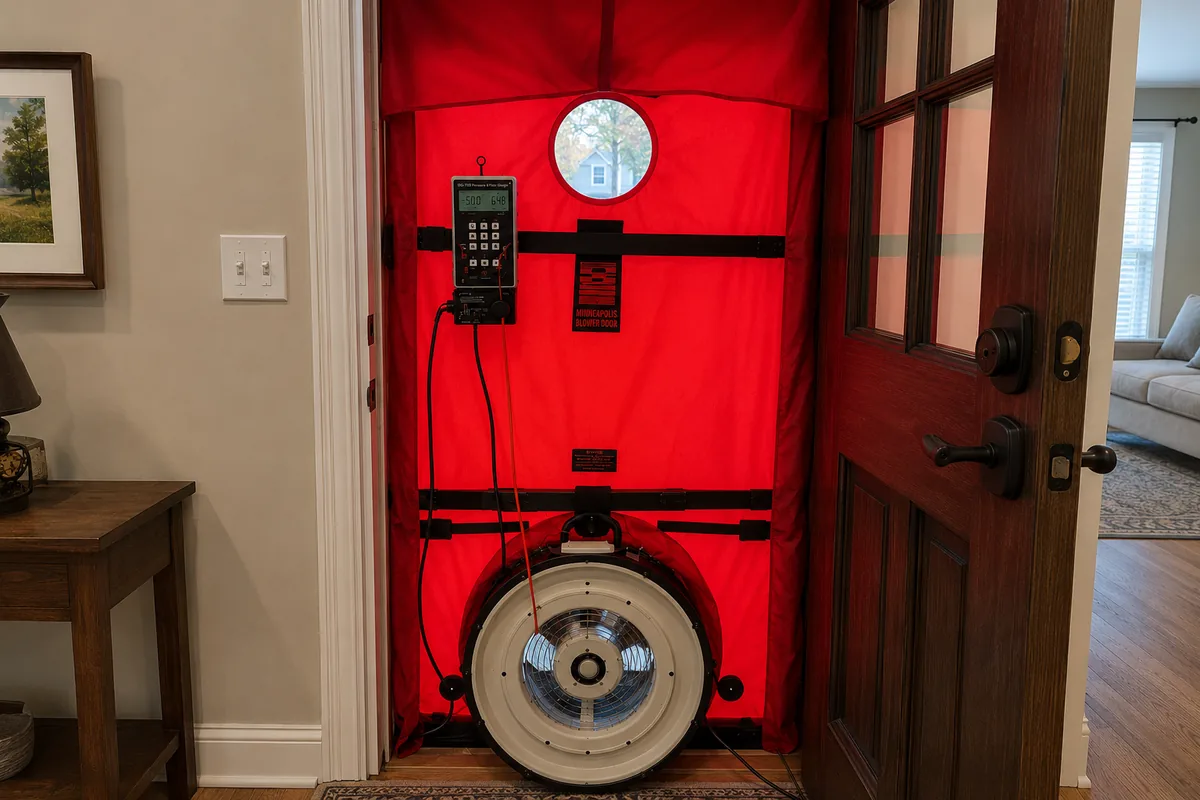
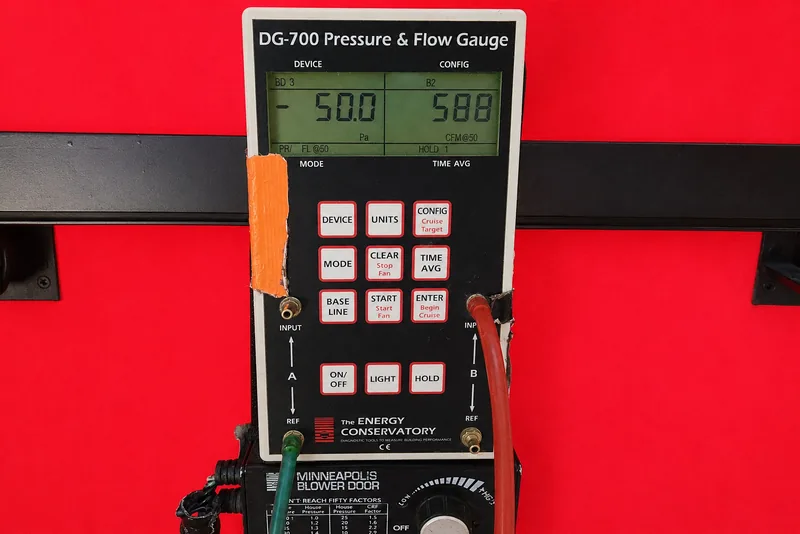
A blower door is a calibrated fan mounted in a doorframe, connected to a pressure gauge and logging software. The fan depressurizes the house to exactly 50 pascals below outdoor pressure, roughly the equivalent of a 20 mph wind pressing on every surface simultaneously. At that pressure, the equipment measures how much air is flowing through the fan to maintain the pressure differential.
That airflow number gets normalized by the volume of the house and converted into ACH50: the number of times per hour the entire house volume would be exchanged with outdoor air if the pressure differential were sustained.
A house testing at 3.0 ACH50 is exchanging its full volume of air with the outdoors three times every hour under those conditions. A house at 10.0 ACH50 is doing it ten times. The lower the number, the tighter the envelope.
The math is simple: ACH50 = CFM50 × 60 ÷ the volume inside the air barrier. A home measuring 1,600 CFM50 with 16,000 cubic feet inside its air barrier tests at 6.0 ACH50.
ACH50 is calculated from the volume enclosed by the home’s tested air barrier, not its floor area. A garage or a vented crawl space outside the air barrier is excluded. A sealed crawl space or sealed attic inside the air barrier counts in the tested volume, even though neither has supply registers.
Worth knowing: ACH50 is not normal air exchange. A result of 5.0 does not mean the house naturally replaces all of its air five times an hour. It describes leakage under the artificial 50-pascal test pressure, which is why the number is only used for comparing envelopes and checking code compliance.
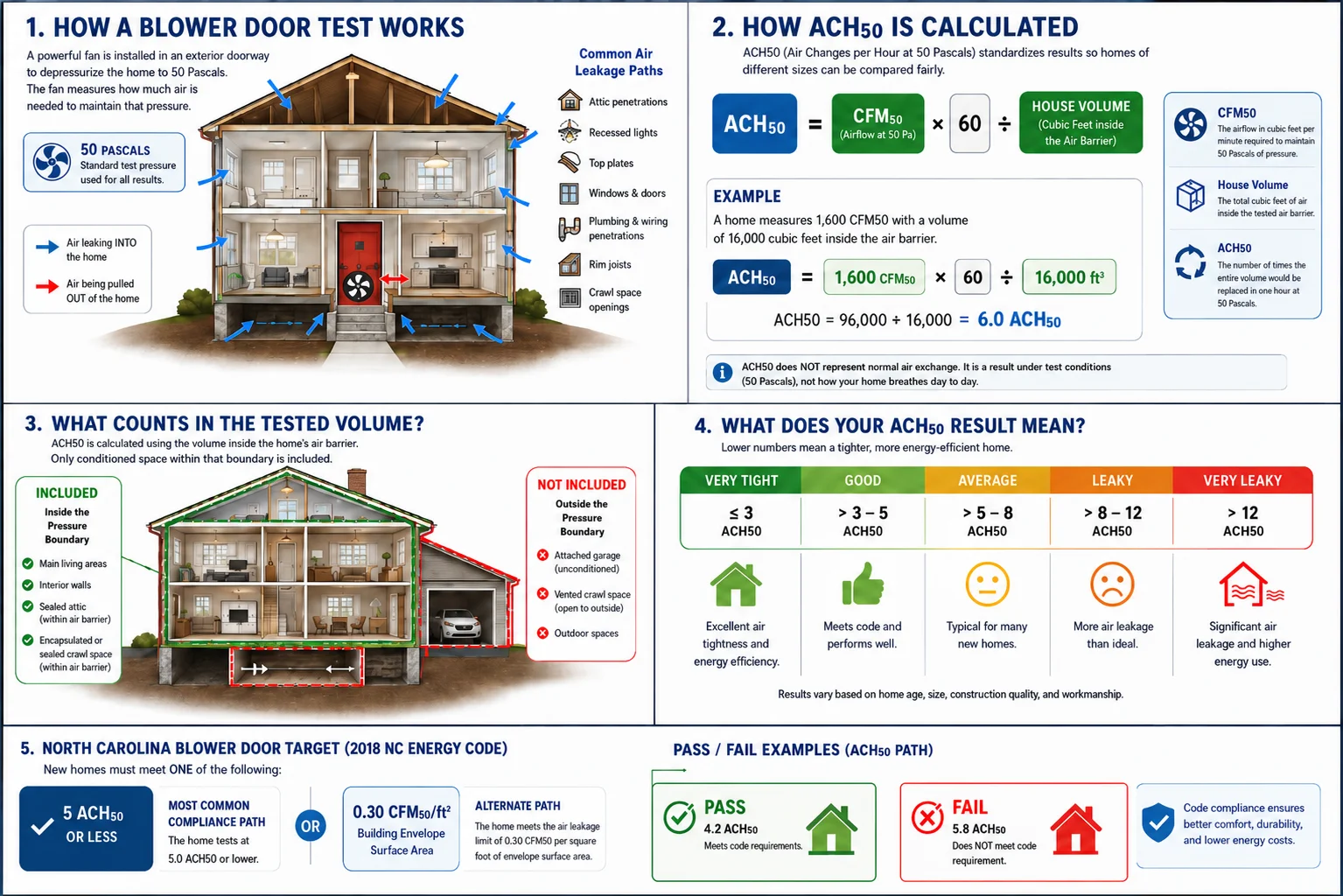
Here is how to read the number at a glance:
| ACH50 result | What it means | Typical next step |
|---|---|---|
| Under 3.0 | Tighter than code; high-performance territory | Confirm mechanical ventilation is adequate |
| 3.0–5.0 | Passes the NC new-construction limit | File the test certificate |
| 5.0–8.0 | Fails code on new construction; moderate leakage in an existing home | Targeted air sealing, then retest if testing for code |
| Above 8.0 | Significant unsealed leakage | Air sealing guided by an energy audit |
What NC Code Requires
Under the currently effective 2018 North Carolina Energy Conservation Code, new residential construction must test at 5.0 ACH50 or less, or meet the alternative limit of 0.30 CFM50 per square foot of building envelope surface area (Section R402.4.2.2). Most builders, testers, and inspectors work from the ACH50 number, so that is the one to know. The code documents are published through the NC Office of State Fire Marshal, and the full testing requirements are covered on our blower door testing service page.
The test is often run at or after rough-in, before finishes are complete, which gives the builder an opportunity to seal any identified leakage before the walls are closed up.
What a Failing Result Means for New Construction
A result above 5.0 ACH50 on a new home does not mean the house needs to be rebuilt. In most cases, it means a relatively small number of penetrations were not sealed during rough-in.
Common failure points on Wake County new construction:
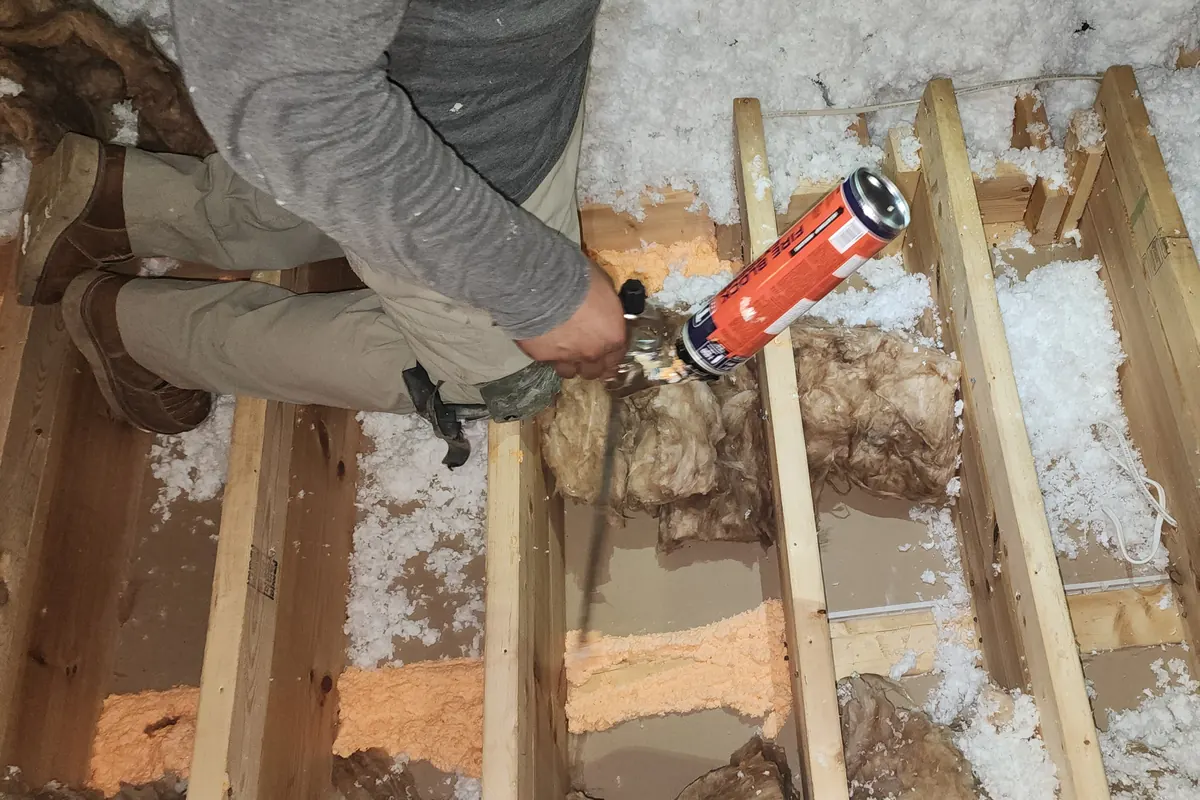
- Top plates where interior partition walls meet the ceiling, particularly at the attic floor
- Recessed light housings that were not specified as airtight fixtures
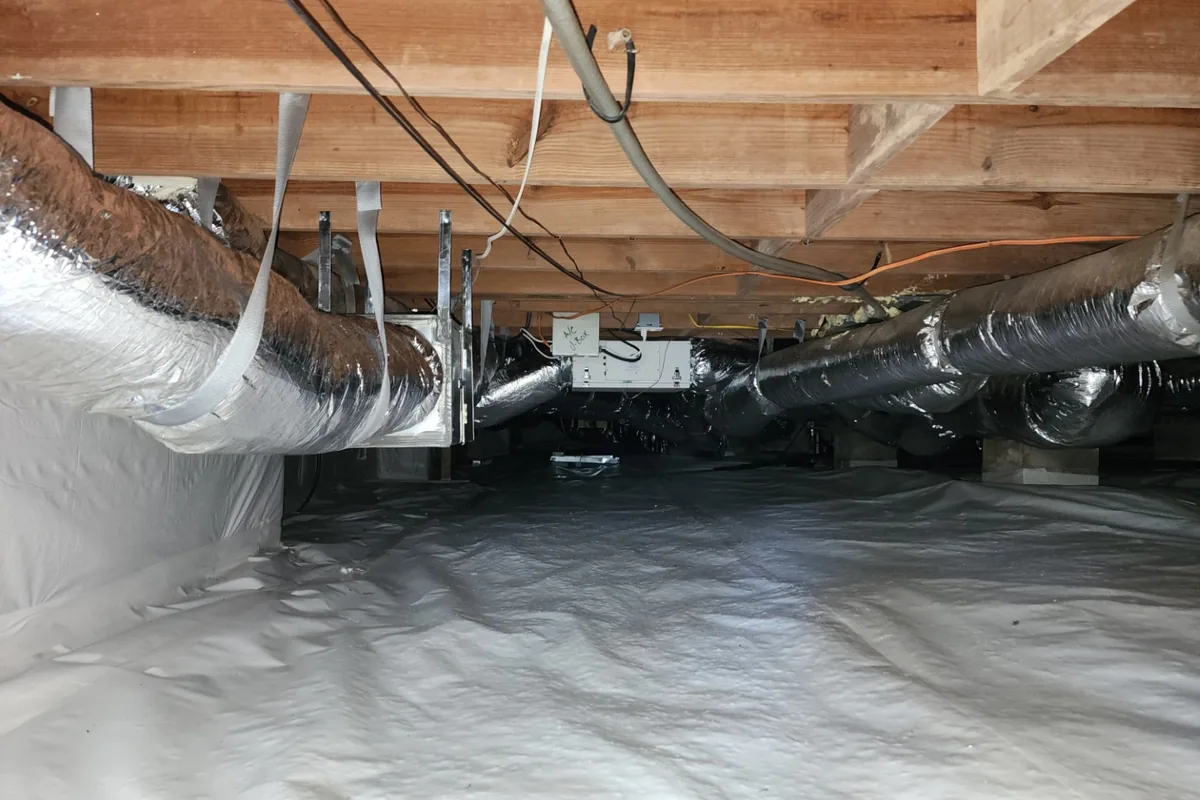
- Plumbing and electrical penetrations through the subfloor into the crawl space
- Band joist connections at floor cavities
- Attic hatch frames without gaskets
Peak Energy, Inc. performs blower door testing across Holly Springs, Raleigh, Fuquay-Varina, and Wake County. When a test fails, the approach is to hold the fan at pressure, walk the house to find where air is moving, seal those paths, and retest. Most homes that fail on first attempt by a moderate margin (say, 5.5–7.0 ACH50) reach compliance in a half-day of targeted sealing.
A written test certificate is issued on passing results for code documentation.
Testing for code, or diagnosing a house?
Builders get a code-compliance test with a written certificate and same-day results. Homeowners get the same fan plus thermal imaging and a full walkthrough in an energy audit.
What the Result Means for an Existing Home
Existing homes are not subject to the 5.0 ACH50 code limit. That threshold applies only to new construction permitted under the 2018 NCECC. But the result still tells you something useful.
An existing home at 4.0 ACH50 has a reasonably tight envelope. Energy loss from air infiltration is not the primary problem. An existing home at 11.0 ACH50 is leaking substantially, and the heating and cooling loads driven by that infiltration are likely visible in the utility bills.
Most existing Triangle homes test in the 6–12 ACH50 range, with older homes in Cary, Raleigh, and Garner built before modern energy codes at the higher end. Results above 15 are unusual. There is no universal passing threshold for an existing home.
The ACH50 number tells you how much the home leaks, not where. Finding the where takes the fan running while someone inspects: that’s what makes a blower door test useful inside a home energy audit, where the auditor walks the house with a thermal camera and smoke pencil checking for air movement at the known leakage sites while the house is held at pressure. For a closer look at how a standalone test and a full audit differ, see blower door test vs. home energy audit.
ACH50 and Your Energy Bills
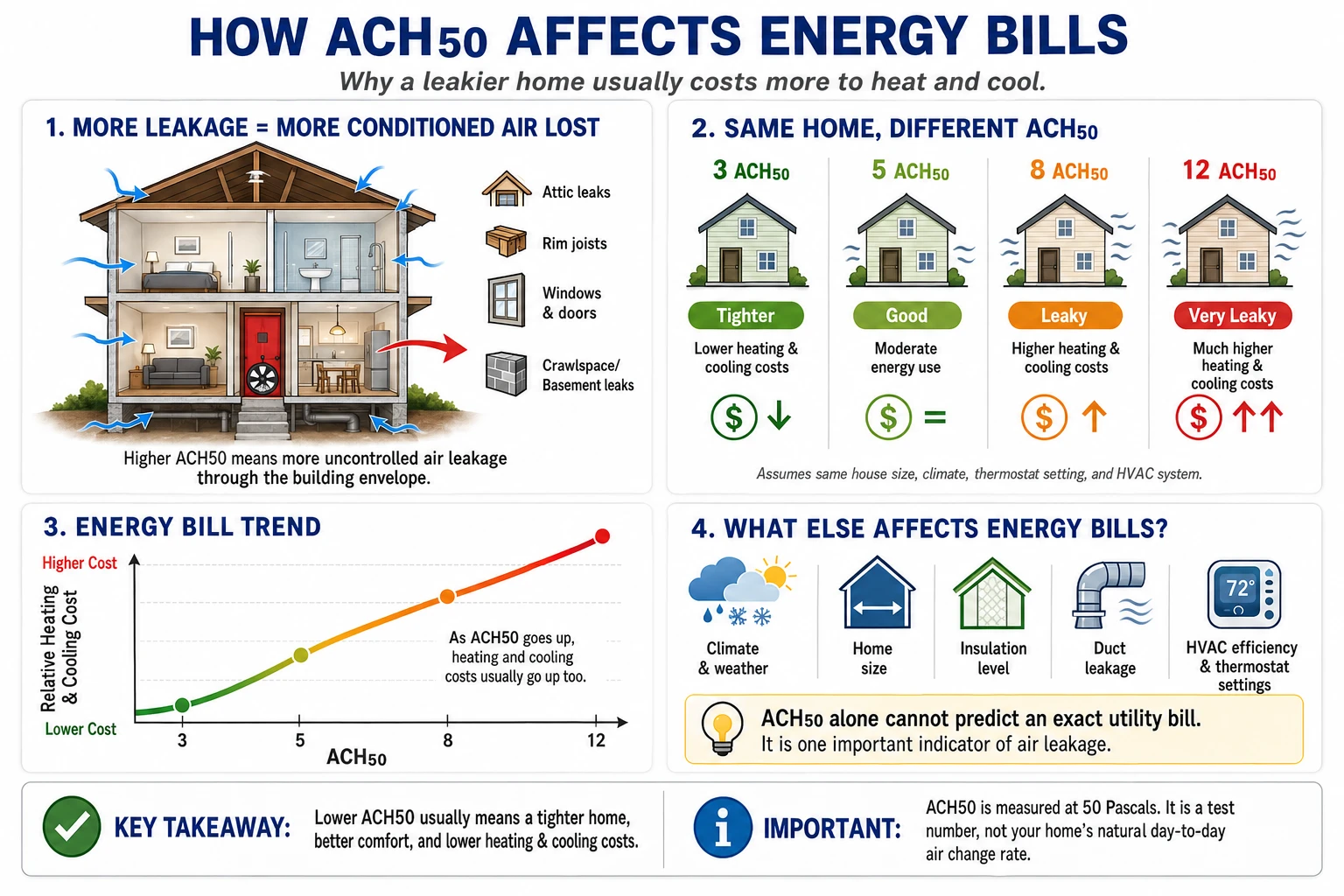
Air infiltration drives two kinds of energy loss. In winter, cold outdoor air enters low in the house (through the crawl space, sill plate, and foundation walls) and pushes warm interior air out near the top (through attic penetrations, top plates, and the ceiling). That stack effect runs continuously whenever there is a temperature difference between inside and outside.
In summer, the same exchange happens in reverse, pulling humid outdoor air into the house. In the Triangle, that means the HVAC system is not just fighting heat but also the latent load from moisture entering through the envelope.
Reducing air leakage lowers heating and cooling loads, but an ACH50 number by itself cannot predict an exact percentage of savings. The actual impact depends on the home’s size and construction, where the leakage paths are, the HVAC system, and the weather. A crawl space full of unconditioned air under the living area typically costs more in heating and cooling bills than the same total leakage spread across a tight attic. If a high bill is what sent you here, why energy bills run high in NC breaks down the usual causes.
A home energy audit in the Triangle pairs the blower door with thermal imaging and duct testing to find which paths are driving the most heat transfer, so sealing work goes where it matters most.
Blower Door Test Cost in NC
Blower door testing in the Triangle starts at $200 for a single house. For builders running code compliance on multiple homes, bundle pricing applies.
Combined blower door and duct leakage testing (the typical code compliance package for new construction) runs around $400 for a single visit, roughly $200 per test. Peak Energy, Inc. issues a written certificate on passing results and can provide retesting if the first attempt does not test at or below 5.0 ACH50. For more on reading the duct side of that package, see duct leakage test results explained.
For homeowners getting a blower door test as part of a home energy audit, the audit fee (an estimated $475–$650+) covers the blower door test, thermal imaging, and an on-site inspection with a walkthrough of the findings. Duct leakage testing is available as an add-on, an estimated $250 per HVAC system, when the ducts need that level of detail.
FAQ
What is a good blower door test result in NC?
For new construction in North Carolina, the 2018 NC Energy Conservation Code requires 5.0 ACH50 or less (or the alternative limit of 0.30 CFM50 per square foot of envelope surface area). A result below 3.0 ACH50 indicates a tighter-than-code envelope. Existing homes are not subject to the code threshold. Most existing Triangle homes test in the 6 to 12 ACH50 range depending on age and construction, and results above 15 are unusual. For an existing home, anything above 8 ACH50 typically means there are significant air sealing opportunities worth addressing.
What happens if a new home fails the blower door test in NC?
If a new construction home tests above 5.0 ACH50, it does not pass the NC Energy Conservation Code envelope requirement. The builder must air seal the identified leakage paths and retest before a certificate of occupancy is issued. Peak Energy, Inc. issues a written test certificate on passing results. A failed test on first attempt is common. Most failures trace to a small number of specific penetrations that can be sealed in a few hours and retested the same day or the next.
How much does a blower door test cost in NC?
Blower door testing in the Triangle starts at $200 for a single house. Combined blower door and duct leakage testing for code compliance runs around $400 for a single visit. Peak Energy, Inc. provides a written test certificate on passing results. Bundle pricing is available for builders testing multiple homes in the same community.
How long does a blower door test take?
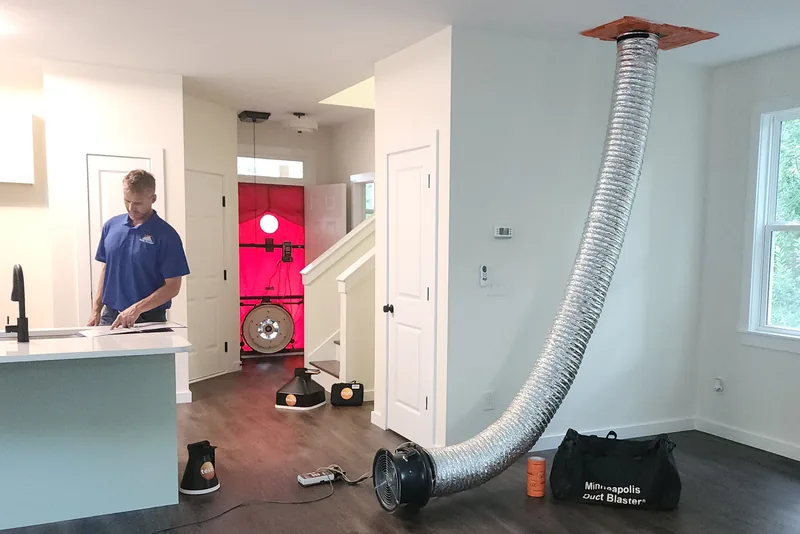
A standalone code-compliance blower door test typically takes 60 to 90 minutes, depending on house size and complexity, and the completed report is left on-site at the time of testing. As part of a home energy audit, the fan stays set up longer while the auditor walks the house with a thermal camera to find where the leakage is happening.
Schedule a Blower Door Test
Need a blower door test in Wake County?
Peak Energy, Inc. provides blower door testing for new construction code compliance and home energy audits across Wake County and the Triangle. Written certificate on passing results. Bundle pricing for builders.
Serving Holly Springs, Fuquay-Varina, Apex, Cary, Raleigh, Garner, and the broader Triangle region.